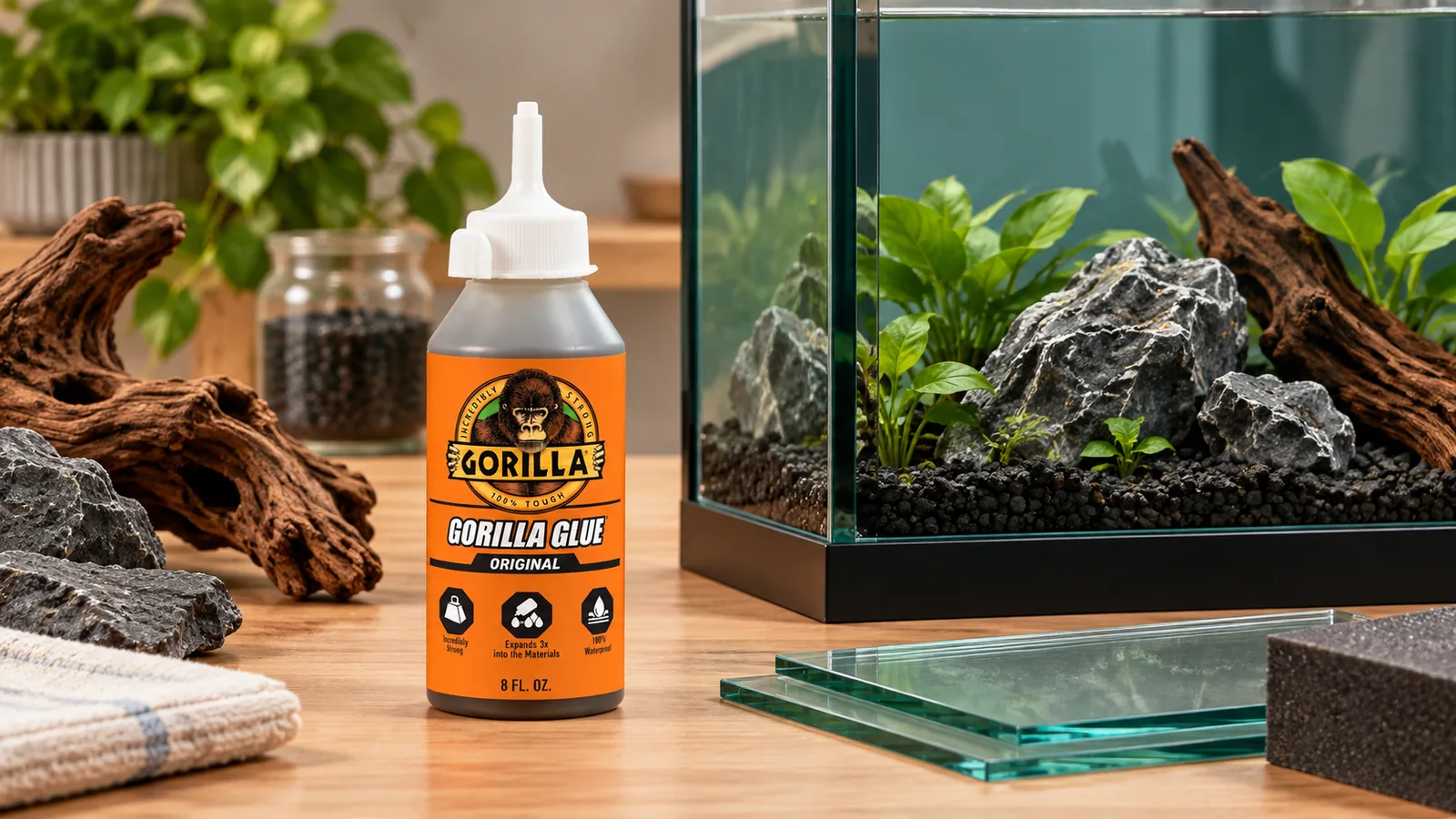
Is Gorilla Glue aquarium safe? You should not assume so simply because a glue is waterproof or dries quickly. Original Gorilla Glue, Gorilla Super Glue Gel and Gorilla-branded epoxies are different formulations, and their suitability for prolonged contact with aquarium water and aquatic life must be evaluated separately.
The safest approach is to choose an adhesive whose manufacturer explicitly identifies aquarium use and the intended task—such as mounting plants or corals versus sealing a tank. The general Gorilla Glue product information reviewed here does not establish an aquarium-specific approval for Original Gorilla Glue or Gorilla Super Glue Gel. That is not proof either product has failed a formal aquarium safety test; it means the approval should not be assumed.
Key Takeaways
- Original Gorilla Glue: A moisture-curing polyurethane adhesive that expands during curing. Gorilla lists a full cure of about 24 hours under its stated product conditions, but waterproof performance is not the same as aquarium suitability.
- Gorilla Super Glue Gel: A cyanoacrylate adhesive that sets in roughly 10–45 seconds. Fast setting is not full curing or evidence of fish-safe, long-term immersion.
- Water exposure matters: Gorilla’s own comparison says a Gorilla Super Glue bond can weaken over time when exposed to water.
- Choose by purpose: For planted tanks, coral mounting or tank sealing, select a product with clear manufacturer instructions for that aquarium application.
- Do not rely on anonymous studies: Unverifiable expert names and unattributed claims are not adequate evidence for animal-safety advice.
Understanding Gorilla Glue
Types Of Gorilla Glue
Gorilla Glue is a brand containing several chemically different products. The name alone does not identify a glue’s behavior or intended use.
| Product | Adhesive type | Manufacturer’s timing | Aquarium-use conclusion |
|---|---|---|---|
| Original Gorilla Glue | Moisture-curing polyurethane; expands while curing. | About 1–2 hours clamping and 24 hours full cure under normal stated conditions. | No aquarium-specific approval established here; avoid using it for a tank without written product-specific confirmation. |
| Gorilla Super Glue Gel | Cyanoacrylate gel; does not foam. | Sets in about 10–45 seconds; Gorilla’s comparison lists 24 hours for full cure. | Fast setting does not confirm continuous-submersion or aquatic-life suitability. |
| Specialty aquarium glue | Varies by product; some are cyanoacrylate gels. | Follow the exact aquarium manufacturer’s directions. | Prefer products expressly labeled for the relevant freshwater or saltwater use. |
Timing and water-resistance information above comes from the manufacturer’s Gorilla Glue vs. Super Glue comparison and Gorilla Super Glue Gel product page. Product labels and regional formulations can change; verify the container you own.
Common Uses
Original Gorilla Glue is designed for many general household bonding tasks, including some exterior repairs. That does not make it a recommended aquarium sealant or a suitable adhesive for items that will remain submerged near fish, shrimp or coral.
Gorilla Super Glue Gel is marketed primarily for quick, precise repairs on materials such as metal, ceramic, rubber, wood and some plastics. Hobbyists may use cyanoacrylate glues in aquascaping, but an aquarium-specific cyanoacrylate product offers more reliable application guidance than assuming all gels are interchangeable.
Summary
Do not label either Original Gorilla Glue or Gorilla Super Glue Gel universally aquarium-safe based only on chemical family or cure time. Obtain confirmation for the exact product and submerged application, or use a purpose-made aquarium adhesive.
Safety Concerns In Aquariums
Potential Risks
- Uncured material: Avoid exposing aquarium livestock to uncured household adhesives without explicit directions authorizing underwater application.
- Foaming and expansion: Original Gorilla Glue expands during curing and may displace small decorations or create unexpected contact surfaces.
- Continuous submersion: A waterproof claim for a cured adhesive is not an aquarium-toxicity assessment. Bond durability under permanent immersion is a separate issue.
- Saltwater and sensitive livestock: Reef systems may impose different chemical and biological demands than household repairs or freshwater decoration.
- Structural safety: A glue used for plants or small rocks is not automatically suitable for a glass seam or a load-bearing aquarium repair.
Ingredients to Consider
Polyurethane and cyanoacrylate describe broad adhesive chemistries, not aquarium certifications. Different products may contain additives, stabilizers and other ingredients. Safety conclusions should refer to the exact formulation, its current documentation and the intended exposure.
Safety Summary
| Question | What can be verified | Practical decision |
|---|---|---|
| Does Original Gorilla Glue cure in seven days? | Gorilla generally lists 24 hours for full cure under its stated conditions; a blanket seven-day claim is unsupported. | Follow the actual label; do not infer aquarium approval from elapsed time. |
| Is Gorilla Super Glue Gel cured in seconds? | It is fast-setting, but setting is different from full cure. | Do not treat 10–45 seconds as an aquarium-safe immersion instruction. |
| Is any cyanoacrylate gel safe for fish? | Some aquarium-specific cyanoacrylate gels are approved for aquarium applications. | Choose a named aquarium product whose instructions cover your task. |
| Does waterproof mean aquarium-safe? | No. Waterproofing and aquatic-life compatibility are different performance questions. | Check explicit aquatic use, curing and long-term exposure requirements. |
Expert Opinions And Studies
Statements From Manufacturers
Gorilla Glue Company
Gorilla describes Original Gorilla Glue as a moisture-cured, expanding polyurethane with a waterproof cured bond. Its Super Glue Gel is a fast-setting cyanoacrylate. The company’s comparison also warns that the Super Glue bond weakens over time when exposed to water. These descriptions do not amount to a published endorsement for an aquarium ecosystem.
For a definitive answer about an individual Gorilla product, contact the manufacturer with the product name, exact variant, substrate, whether it will be continuously submerged, and whether the tank houses freshwater or marine livestock. Ask specifically whether that formulation is recommended for the intended use.
Research And Findings
Chemical Composition and Toxicity
Claims that a cured household glue has no effect on any species of fish, invertebrate or coral require product-specific evidence. We could not substantiate the original article’s references to an “Aquarium Life Sciences Review” study or the quoted marine-biologist recommendation. Those unverified claims should not be republished as scientific findings.
There is, however, verifiable evidence that some specific cyanoacrylate products are marketed for aquarium use: Seachem states that its Flourish Glue can attach plants and moss in freshwater or saltwater aquariums, including underwater applications; its Reef Glue is intended for mounting coral fragments and colonies. These approvals apply to those products, not to every adhesive with similar chemistry.
Experts’ Recommendations
Use the product maker’s technical documentation, aquarium-specific intended use and the tank builder’s guidance rather than relying on untraceable expert endorsements. For structural seams or damaged glass, follow the aquarium manufacturer’s repair guidance or consult an experienced aquarium professional.
User Experiences And Anecdotes
Success Stories
Aquascapers commonly report using cyanoacrylate gels for moss, rhizome plants and coral fragments. Those stories can suggest a technique worth investigating, but they are not controlled toxicity testing and do not prove that a particular Gorilla formulation is approved for permanent immersion.
Reported Issues
Problems may include failed adhesion on wet or unsuitable surfaces, decorations shifting before full set, visible white residue, poor long-term durability and attempts to repair a tank seam with an adhesive not designed for that task. A successful short-term bond does not establish long-term structural or livestock safety.
User Feedback Summary
| Experience | What it tells you | What it does not prove |
|---|---|---|
| A cyanoacrylate gel holds a plant to driftwood. | The technique can work mechanically. | That all cyanoacrylate products are aquarium-certified. |
| A waterproof polyurethane bond holds a decoration. | It may adhere after curing. | That it is safe for all aquatic animals or continuously submerged use. |
| An aquarium-branded glue has use directions for reefs. | The manufacturer specifically supports that application. | That it can also repair a tank’s structural glass seams. |
Alternatives To Gorilla Glue In Aquariums
Aquarium-Safe Adhesives
Aquarium Silicone
For tank seams and certain glass repairs, use a silicone sealant specifically formulated and labeled for aquariums, following the tank manufacturer’s repair specifications. Aqueon Aquarium Silicone Sealant is marketed for freshwater and saltwater aquariums. Observe the exact product’s preparation, cure and leak-test instructions before returning livestock.
Aquarium Epoxy and Aquascaping Putty
For securing rockwork or aquascaping structures, choose an epoxy putty expressly approved for your tank type and task. Some products are designed for underwater use; others require dry application and curing. Do not assume that a general-purpose household epoxy is aquarium-safe after any fixed number of hours.
DIY Solutions
Cyanoacrylate Glue Made for Aquariums
Seachem Flourish Glue is specifically intended for attaching plants, moss and similar materials in aquariums. Seachem Reef Glue is intended for mounting coral fragments and colonies. Follow the respective instructions and do not substitute them for sealant used to hold a tank together.
What Not to Substitute
Do not use an unlabeled “100% silicone” household caulk merely because it contains silicone: some versions include additives and have no aquarium approval. Likewise, ordinary craft glue, construction adhesive or waterproof repair products should not replace a purpose-made aquarium sealant.
| Aquarium task | Better-documented option | Check |
|---|---|---|
| Attach moss or plants | Seachem Flourish Glue or another aquarium-specific adhesive. | Freshwater/saltwater instructions and substrate restrictions. |
| Mount coral fragments | Seachem Reef Glue or another reef-specific adhesive. | Compatibility with the species, placement and tank method. |
| Seal an aquarium seam | Purpose-made aquarium silicone. | Structural suitability, full cure and leak-testing. |
| Secure large rockwork | Aquarium-approved epoxy/putty and appropriate structural support. | Submersion, load and cure requirements. |
Conclusion
There is no good basis for saying that all cured Gorilla Glue is aquarium-safe or that Gorilla Super Glue Gel may always be submerged immediately. Original Gorilla Glue’s expanding polyurethane chemistry and Gorilla Super Glue Gel’s fast-setting cyanoacrylate behavior are documented, but aquarium-specific approval for these exact products has not been established by the referenced manufacturer information.
When fish, shrimp or coral are involved, use an adhesive that explicitly supports the actual aquarium application, follow its directions and avoid testing an unverified glue on live animals.
Frequently Asked Questions
Is Gorilla Glue safe for aquarium use?
Do not assume it is. The exact formulation and aquarium application must be verified. Waterproof or fully cured does not automatically mean safe for aquatic life.
How long does Gorilla Glue need to cure before it’s safe for aquarium use?
Gorilla generally lists about 24 hours for full cure of Original Gorilla Glue under its stated conditions, but that figure is not an aquarium safety waiting period. Use only a product with the appropriate submerged-use instructions.
Can I submerge Gorilla Super Glue Gel immediately after application?
The manufacturer lists a fast setting time, not a blanket permission for immediate aquarium submersion. Choose an explicitly aquarium-approved gel if you need underwater application.
What are the risks associated with using Original Gorilla Glue in fish tanks?
It expands while curing, and neither a waterproof claim nor an ordinary cure time proves compatibility with aquatic animals or continuous immersion.
Are there alternatives to Gorilla Glue that are safe for aquariums?
Yes. For example, Aqueon makes aquarium silicone sealant, while Seachem markets Flourish Glue for aquarium plants and Reef Glue for coral mounting. Use each only for the purpose in its instructions.
How do I ensure an adhesive is aquarium-safe?
Check the exact name and formulation, manufacturer’s aquarium-specific claim, freshwater or saltwater compatibility, surfaces, submerged-use directions and curing requirements. For repairs affecting tank integrity, follow the aquarium maker’s instructions.
Can I use any Gorilla Glue product in my aquarium?
No universal approval can be inferred across the brand. Contact Gorilla for written, product-specific guidance if you want to use one of its products in a continuously submerged aquarium application.