To remove sticker residue from metal, warm the adhesive, lift softened glue with a plastic scraper, dissolve the remaining film with isopropyl alcohol or a compatible oil, then wash and dry the surface. The safest method depends on the finish: painted, anodized, plated, and clear-coated metal need milder treatment than bare stainless steel.
Key facts at a glance
A hair dryer softens most pressure-sensitive adhesives in 30-90 seconds.
Isopropyl alcohol is the best first solvent for many painted and stainless-steel surfaces.
Acetone works quickly on some bare metals but can damage paint, lacquer, plastic, and clear coats.
Plastic cards and nylon scrapers remove softened glue without the scratches caused by steel wool.
Oil-based removers usually need 1-5 minutes of dwell time and require soap-based degreasing afterward.
Typical household jobs cost $0-$15 and take 5-20 minutes, excluding unusually old or baked-on adhesive.
What Do You Need Before Removing Adhesive?
Most small metal-label jobs require a hair dryer, microfiber cloths, a plastic scraper or expired bank card, dish soap, warm water, and one compatible remover. Start with the least aggressive combination because the finish can be more vulnerable than the adhesive.
Before you start
| Requirement | Typical specification | Purpose |
|---|---|---|
| Hair dryer | Low or medium setting, 15-30 cm away | Softens glue without concentrated heat |
| Plastic scraper | Edge angle below 30 degrees | Lifts residue without scoring metal |
| Isopropyl alcohol | 70% or 90%, 5-10 mL | Dissolves light adhesive film |
| Household oil | 5-10 mL | Loosens thick, rubbery residue |
| Microfiber cloth | 2-4 clean cloths | Wipes dissolved adhesive |
| Dish soap | 1 teaspoon in 250 mL water | Removes oily solvent residue |
Work in ventilation, keep solvents away from flames and sparks, and wear nitrile gloves when using alcohol, mineral spirits, or commercial adhesive removers. Disconnect powered devices before applying any liquid, and never allow solvent to run into seams, switches, ports, or ventilation openings.
How Do You Remove Sticker Residue From Metal?
The most reliable process has six steps and usually takes 5-20 minutes: identify the finish, warm the label, lift the bulk, dissolve the film, wipe in one direction, and wash the surface. The factor that determines success is compatibility between the remover and the metal’s coating, not solvent strength alone.
Step 1: Identify the metal finish
Inspect the object under bright light and determine whether the surface is bare, painted, powder-coated, anodized, plated, brushed, polished, or clear-coated. A silver appearance does not prove that the surface is bare aluminum or stainless steel; many products use a transparent protective layer.
Test the chosen remover on a hidden 1 cm area. Apply one drop, wait two minutes, wipe it away, and check for color transfer, dullness, swelling, tackiness, or a change in gloss.
You’ll know it worked when: the test area looks and feels unchanged after drying.
Common mistake: testing on the sticker itself instead of an exposed area, which hides coating damage.
Step 2: Warm the sticker and adhesive
Set a hair dryer to low or medium heat and hold it 15-30 cm from the label. Move continuously for 30-90 seconds; large labels may need 2-3 minutes. The surface should feel warm, not painfully hot, and the adhesive should become softer at the edge.
Avoid heat guns unless you can control the temperature and distance. A heat gun can soften plastic trim, blister paint, distort thin aluminum, or raise a localized metal temperature far above the adhesive’s softening point.
You’ll know it worked when: the label edge bends instead of tearing and the glue stretches slightly.
Common mistake: heating one spot continuously, which creates a hot zone and may discolor a coating.
Step 3: Lift the label and bulk adhesive
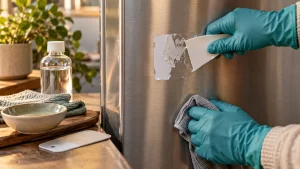
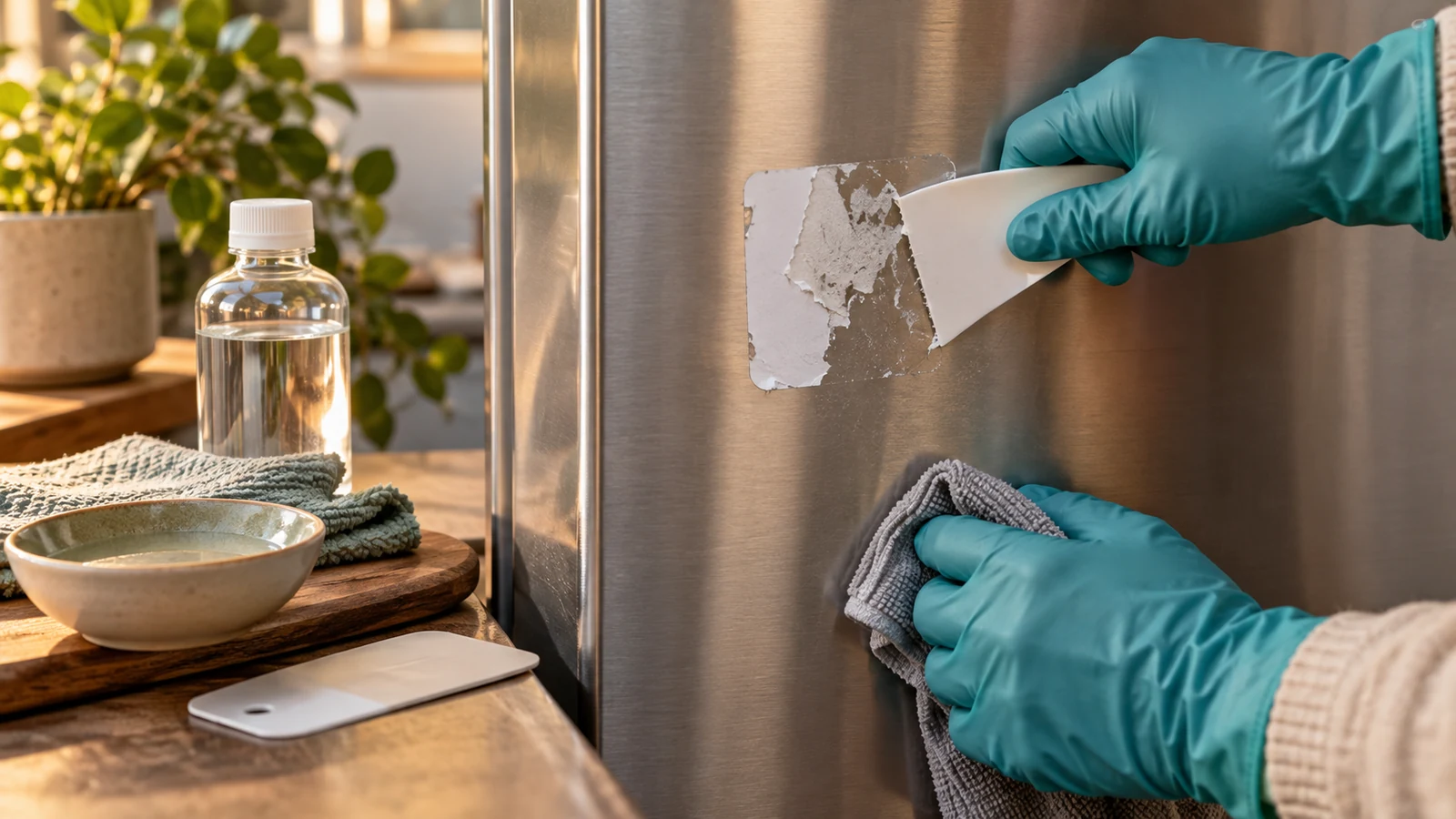
Peel from one corner at a low angle, pulling the label back over itself rather than straight upward. Use a plastic card or nylon scraper to push beneath stubborn sections. Keep the tool nearly parallel with the metal and work with the grain on brushed stainless steel.
For a thin remaining film, press duct tape or packing tape onto the residue, rub firmly, and pull it away quickly. Fresh tape can bond to loose adhesive more effectively than a liquid solvent.
You’ll know it worked when: most of the paper and thick glue leaves in strips rather than small crumbs.
Common mistake: using a knife or razor at a steep angle, which can leave permanent scratches.
Step 4: Apply the mildest suitable remover
Dampen a microfiber cloth rather than flooding the metal. For light residue, use 70% or 90% isopropyl alcohol and hold the cloth against the glue for 30-120 seconds. For thick rubbery residue, apply a small amount of vegetable oil, citrus adhesive remover, or a petroleum-based product for 1-5 minutes.
Do not mix solvents in a container. Use one product, remove its residue, and only then consider a stronger option.
You’ll know it worked when: the adhesive rolls, smears easily onto the cloth, or loses its rubbery pull.
Common mistake: rubbing immediately with a dry cloth, which spreads softened glue over a larger area.
Step 5: Wipe and scrape in controlled passes
Wipe in short, overlapping passes with a clean section of cloth. Use the plastic scraper only when the adhesive has softened. Replace the cloth as soon as it becomes sticky, because a saturated cloth redeposits glue.
On brushed stainless steel, follow the existing grain. On polished metal, use straight passes rather than circular scrubbing, which can create visible haze.
You’ll know it worked when: the surface feels smooth when checked with a clean fingertip or fresh microfiber cloth.
Common mistake: pressing harder instead of extending the solvent dwell time.
Step 6: Wash, rinse, and dry
Mix approximately 1 teaspoon of dish soap with 250 mL of warm water. Wash the treated area, rinse with clean water, and dry immediately with a lint-free cloth. This step removes oily films from WD-40, mineral spirits, vegetable oil, and many citrus products.
Leave no solvent pooled around seams, rivets, trim, or gaskets. Oily residue attracts dust and can create a visible dark patch on brushed or matte finishes.
You’ll know it worked when: the surface has uniform gloss, no tack, and no oily drag under the cloth.
Common mistake: stopping after the glue disappears and leaving a solvent film that later collects dirt.
Which Remover Works Best on Each Metal Surface?
Isopropyl alcohol is the best general first choice for light residue, while oil-based products handle thick adhesive with lower immediate coating aggression. Acetone is the fastest common solvent for compatible bare metal, but its damage risk makes it a poor default for unknown finishes.
| Remover | Typical dwell time | Best use | Main risk |
|---|---|---|---|
| 70% isopropyl alcohol | 30-120 seconds | Light residue, stainless steel, many painted surfaces | Can affect some inks and soft coatings |
| Vegetable or mineral oil | 5-30 minutes | Thick rubber adhesive, delicate unknown finishes | Leaves an oily film |
| Goo Gone or citrus remover | 1-5 minutes | Old labels and broad residue areas | Fragrance, staining, degreasing required |
| WD-40 | 1-5 minutes | Water-resistant, rubbery adhesive | Petroleum film and odor |
| Mineral spirits | 1-5 minutes | Heavy adhesive on compatible bare metal | Flammable, coating compatibility concerns |
| Acetone | 10-30 seconds | Compatible bare stainless steel or aluminum | Removes paint, lacquer, plastic, and some finishes |
| White vinegar | 5-15 minutes | Limited help with light residue or mineral contamination | Usually weak against pressure-sensitive glue |
Is rubbing alcohol safe on metal?
Isopropyl alcohol is generally suitable for bare stainless steel and many durable painted metal surfaces after a spot test. Alcohol removes light adhesive by penetrating the residue, but it may soften fresh paint, printed markings, rubber seals, or clear finishes, so use a damp cloth rather than prolonged soaking.
Alcohol is especially useful on appliance handles, stainless-steel trim, and small label remnants. It is less effective against thick foam tape or adhesive that has hardened after years of heat exposure.
Can you use acetone on stainless steel?
Acetone can remove adhesive from many bare stainless-steel surfaces, but stainless steel is not automatically acetone-safe. Brushed grain, mirror polish, lacquer, anti-fingerprint coatings, printed graphics, plastic trim, and silicone joints may react differently.
Use no more than a few milliliters on a cloth, keep contact under 30 seconds, and wipe immediately. Never use acetone near plastic bezels, painted panels, acrylic parts, appliance controls, or an unknown clear coat.
How Long Does Each Method Take and Cost?
A typical small residue-removal job costs $0-$15 and takes 5-20 minutes. Heat and alcohol are usually fastest for thin films, while oil-based treatments cost less but require longer dwell time and a separate degreasing wash.
| Method | Typical material cost | Dwell or working time | Total small-job time |
|---|---|---|---|
| Hair dryer and plastic card | $0-$5 | 30-180 seconds | 2-8 minutes |
| Isopropyl alcohol | $3-$8 | 30-120 seconds | 5-12 minutes |
| Vegetable oil | $0-$5 | 5-30 minutes | 10-40 minutes |
| Goo Gone or citrus remover | $6-$12 | 1-5 minutes | 5-15 minutes |
| WD-40 | $5-$10 | 1-5 minutes | 6-18 minutes |
| Acetone | $5-$12 | 10-30 seconds | 2-8 minutes |
| Professional removal service | $50-$200 | Varies | 30-120 minutes |
The figures are typical US retail and labor ranges, not fixed prices. Larger panels, multiple labels, automotive detailing, and hazardous-access locations increase the total.
Which Method Is Safest for Different Metal Finishes?
The safest method is heat plus plastic scraping for unknown finishes, followed by a spot-tested alcohol or oil treatment. Bare metal tolerates more solvent exposure, while anodized, painted, plated, and clear-coated surfaces require short contact and immediate wiping.
| Surface or object | First choice | Avoid initially | Finish-specific instruction |
|---|---|---|---|
| Brushed stainless steel | Hair dryer, alcohol | Steel wool, cross-grain scrubbing | Wipe parallel with the grain |
| Painted steel | Low heat, alcohol spot test | Acetone, aggressive scraping | Stop if color transfers to cloth |
| Powder-coated metal | Warm water, mild oil | Strong ketones and prolonged heat | Use light pressure |
| Anodized aluminum | Warm water, alcohol spot test | Abrasive pads, strong alkalis | Preserve the anodized layer |
| Bare aluminum | Oil, alcohol, short acetone test | Caustic cleaners | Watch for dulling or discoloration |
| Chrome-plated metal | Warm water, diluted alcohol | Abrasive powders, acetone | Protect the plating and edges |
| Laptop or electronic casing | Tape lift, barely damp alcohol cloth | Spraying liquid directly | Keep liquid away from ports |
| Automotive painted panel | Heat, automotive adhesive remover | Acetone and razor blades | Test clear coat in a hidden area |
How do you remove old glue from painted metal?
Remove old glue from painted metal with low heat, a plastic card, and a spot-tested alcohol or automotive adhesive remover. Work in small 5-10 cm sections, keep solvent contact below two minutes, and stop immediately if paint transfers to the cloth or the gloss changes.
Painted metal needs a different risk calculation from bare steel. The objective is to dissolve adhesive without attacking the binder, clear coat, or decorative print underneath.
What Should You Do About Stubborn or Baked-On Residue?
Stubborn residue needs repeated short treatments rather than one aggressive application. Warm the area, remove the softened top layer, reapply a compatible remover for 2-5 minutes, and scrape gently; thick adhesive often has several layers with different hardness.
Foam tape and mounting adhesive
Cut or roll away the foam mechanically with a plastic scraper. Apply oil or a commercial adhesive remover to the remaining rubber layer, wait 5-10 minutes, then wipe in one direction.
Residue exposed to sunlight or heat
Use several 30-60 second heat cycles. Aged adhesive may have oxidized into a harder skin, so remove the surface crust first and let the solvent reach the lower layer.
Industrial adhesive on bare metal
A trained user may use acetone followed immediately by mineral spirits on compatible bare metal. Acetone dissolves the polymer quickly, while mineral spirits can help keep the dissolved material mobile long enough to wipe it away instead of allowing a thin film to re-form.
This combination is flammable and unsuitable for painted, plated, plastic, or unknown surfaces. Use ventilation, eliminate ignition sources, wear solvent-resistant gloves, and dispose of wet cloths according to local fire-safety guidance.
Why Does Sticker Glue Smear Instead of Lift?
Sticker glue smears when the solvent softens the adhesive faster than the cloth can remove it, or when the cloth is already saturated. Smearing is not evidence that the solvent failed; it usually means the process needs smaller sections, more clean cloth, and a defined dwell time.
| Failure | Likely cause | Recovery |
|---|---|---|
| Glue spreads into a larger patch | Excess solvent or saturated cloth | Stop, change cloth, work in 5 cm sections |
| Residue stays rubbery | Insufficient dwell time | Reapply for 2-5 minutes |
| Surface becomes cloudy | Coating reaction or residue film | Remove solvent, wash gently, stop stronger chemicals |
| Paint appears on cloth | Coating damage | Stop immediately and let surface dry |
| Oily haze remains | Petroleum or vegetable oil | Wash with diluted dish soap |
| Scratches appear | Metal tool or abrasive pad | Stop; do not polish aggressively without matching finish |
What Mistakes Permanently Damage Metal?
Steel wool, wire brushes, abrasive powders, and untested razor blades can scratch polished or brushed metal permanently. Acetone on painted metal, excessive heat on thin panels, and solvent pooling around plastic components can cause damage that cleaning cannot reverse.
Avoid these errors:
- Scrubbing across stainless-steel grain: the crosswise marks catch light and remain visible after the glue is gone.
- Using a sharp blade vertically: a nearly upright edge concentrates force into a narrow scratch.
- Leaving oil overnight without a reason: extended dwell can stain porous coatings and increases cleanup.
- Spraying remover directly onto electronics: liquid can migrate beneath keys, bezels, seals, or circuit-board openings.
- Combining solvents: mixtures can change evaporation, flammability, and coating behavior unpredictably.
- Assuming bare-looking aluminum is uncoated: anodizing and clear finishes can be thin, colored, and easy to damage.
A useful practitioner rule is to increase dwell time before increasing chemical strength. Adhesive often responds better to 5 minutes of compatible softening than to 10 seconds of a destructive solvent.
Can You Remove Sticker Residue Without Chemicals?
You can remove light sticker residue without liquid chemicals by using heat, a plastic card, adhesive tape, or a rubber adhesive-removal block. Mechanical methods are safest for electronics and unknown coatings, although thick or aged residue usually needs a small amount of compatible solvent.
Press fresh tape onto the residue several times, changing the contact area as it becomes loaded. For larger areas, warm the adhesive first and roll it into a ball with a clean fingertip or rubber block.
Do not use an abrasive rubber block on high-gloss paint, mirror-polished metal, or soft anodized aluminum without testing. Friction can create dull patches even when it does not create obvious scratches.
How Should You Clean the Surface Afterward?
Wash the area with diluted dish soap after using oil, WD-40, citrus remover, or mineral spirits, then rinse and dry it completely. Alcohol usually evaporates cleanly, but washing remains useful when the cloth has redistributed adhesive or removed surface dirt.
For stainless steel, finish with a clean microfiber cloth along the grain. Avoid household window cleaner containing ammonia on unknown metal finishes, and avoid chlorine bleach because chloride exposure can promote staining or corrosion on stainless steel.
Frequently Asked Questions
Does vinegar remove sticker residue from metal?
Vinegar may soften some light residue, but acetic acid is usually less effective than isopropyl alcohol or an oil-based remover against pressure-sensitive adhesive. Apply diluted vinegar for 5-15 minutes only after a spot test, then wash the surface. Do not expect vinegar to dissolve thick foam tape or cured industrial glue.
Is Goo Gone better than WD-40 for metal?
Goo Gone is usually more purpose-built for adhesive residue, while WD-40 is useful when a petroleum film can be cleaned afterward. Both require washing, and neither should be assumed safe for painted, anodized, plated, or clear-coated metal without a compatibility test. Choose Goo Gone for glue-focused work and WD-40 for a readily available household option.
Can a razor blade remove sticker glue from stainless steel?
A razor blade can remove residue from some flat, bare stainless-steel surfaces, but it can scratch brushed, polished, coated, or curved metal. A plastic scraper is safer for most household objects. If a blade is unavoidable, keep it nearly flat, lubricate the residue, and move only in the existing grain direction.
How do you remove sticker residue from an aluminum laptop?
Turn off and unplug the laptop, remove the label mechanically, and wipe remaining residue with a barely damp cloth containing a small amount of isopropyl alcohol. Never pour or spray liquid onto the casing, and keep solvent away from ports, seams, keyboards, and display edges. Test first because aluminum laptops commonly use anodized or painted finishes.
Why does old sticker residue become harder to remove?
Old adhesive loses volatile components, oxidizes, and can cross-link under ultraviolet light and heat. The remaining polymer becomes less fluid and bonds more strongly to microscopic surface texture. Heat restores some flexibility, while a solvent with enough dwell time reduces cohesive strength so the residue can be wiped away.
What is the best overall process for unknown metal?
Use low heat, a plastic scraper, and a small isopropyl alcohol spot test. If alcohol affects the finish, switch to a small amount of household oil and wash afterward. This sequence limits scratching and coating damage while still handling most light and medium sticker residue.
The Bottom Line
To remove sticker residue from metal, begin with a hair dryer and plastic scraper, then use spot-tested isopropyl alcohol for light residue or oil-based remover for thick glue. Reserve acetone for compatible, confirmed bare metal, keep solvent contact brief, and always wash away oily residue. The safest successful method is the least aggressive one that fully removes the adhesive.