Quick answer: To make super glue stronger, improve surface contact and joint design rather than mixing household additives into the glue. Clean compatible materials, make the parts fit closely, apply a thin film and hold them still through the specified cure. Choose a different adhesive when the repair needs flexibility, a large gap or repeated peeling resistance.
Ever found yourself frustrated when your super glue just doesn’t hold up as expected? You’re not alone. While super glue is known for its quick bonding and strength, there are ways to make it even more effective. Whether you’re fixing a broken item or working on a DIY project, a few simple tweaks can significantly enhance its adhesive power.
Key Takeaways
- Surface Preparation is Crucial: Clean, dry, and grease-free surfaces ensure a stronger adhesive bond with super glue.
- Enhancing Bond Strength: Baking soda can accelerate hardening, but a faster set does not demonstrate a stronger joint.
- Using Activators for Faster Bonding: Spraying an activator on one surface before applying the glue helps speed up the bonding process, especially for larger or tricky surfaces.
- Material Compatibility Matters: Ensure that the materials you’re bonding are compatible with super glue; some materials like Teflon and silicone may not bond effectively.
- Proper Application Techniques: Applying the right amount of glue and pressing surfaces together firmly are essential for optimal bonding results.
Understanding Super Glue
Super glue, also known as cyanoacrylate adhesive, is a fast-bonding, high-strength adhesive commonly used in various applications. It’s essential to grasp its properties and usage to maximize its effectiveness.
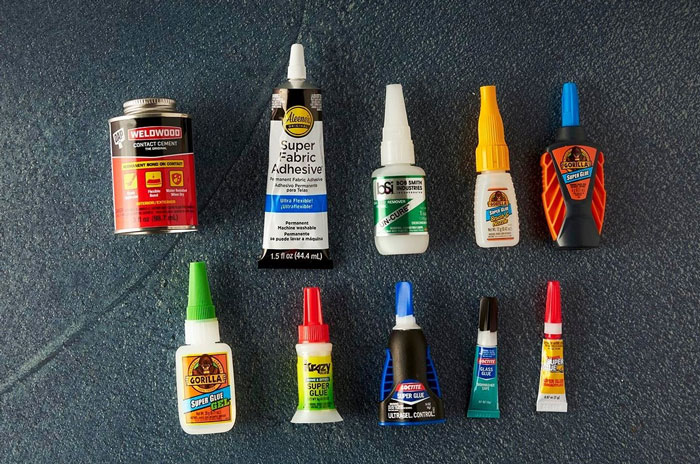
Key Components
- Cyanoacrylate: The primary chemical in super glue responsible for rapid bonding.
- Curing Process: The process where the glue hardens and bonds surfaces together.
Characteristics
- Fast Bonding: Super glue typically bonds surfaces in seconds.
- High Strength: Once fully cured, it forms a strong, durable bond.
- Versatility: Suitable for materials like metal, plastic, ceramic, and more.
Common Frustrations
Many users experience adhesive failures due to improper application or surface preparation. Understanding super glue’s properties helps mitigate these issues.
Application Steps
- Surface Preparation: Ensure surfaces are clean, dry, and free from grease or dust.
- Apply Glue Sparingly: A small amount is usually sufficient for a strong bond.
- Press Surfaces Together: Hold surfaces together firmly for at least 30 seconds.
Enhancing Effectiveness
Adding Baking Soda
- Process: For a stronger repair, prioritize a close fit and a thin glue film; use additives only when the adhesive manufacturer specifies them.
- Benefits: Fills gaps, accelerates curing, and enhances bond strength.
Using Activators
- Process: Apply an activator spray to one surface before applying glue to the other. Press surfaces together immediately.
- Benefits: Speeds up bonding, particularly useful for large or challenging surfaces.
Data on Bond Strength
| Method | Average Bond Time (seconds) | Average Strength (psi) |
|---|---|---|
| Standard Use | 30-60 | Depends on glue and test method |
| Baking Soda | 10-20 | No verified additive strength value |
| Activator | 5-10 | Consult the approved accelerator system |
Summary
To enhance super glue’s performance, prepare surfaces properly and consider additives like baking soda or activators. Faster curing and improved bond strength are separate outcomes; do not assume an accelerator produces both. Proper application can significantly improve your repairs and projects.
Factors Affecting Adhesive Strength
The strength of super glue, or cyanoacrylate, depends on several critical factors. Understanding these variables ensures optimal bonding for your projects.
Material Compatibility
Material compatibility plays a vital role in adhesive strength.
- Moisture Content: Super glue bonds best with materials with high moisture content. Wood, metal, and some plastics offer excellent bonding surfaces due to their inherent moisture.
- Non-Compatible Materials: Teflon, silicone, and certain plastics may not bond effectively with super glue. The lack of moisture in these materials hinders the curing process.
Surface Preparation
Proper surface preparation is essential for a strong adhesive bond.
- Clean Surfaces: Ensure surfaces are free from dirt, oil, or grease. Even small contaminants can significantly reduce bonding strength.
- Dry Surfaces: Moisture can interfere with the adhesive’s curing process. A dry surface facilitates better bonding.
- Texture and Abrasion: Lightly sanding or roughening the bonding surfaces can enhance adhesion by providing more surface area for the glue to grip.
Enhancing Adhesive Strength
To further improve the effectiveness of super glue, certain additives and techniques can be employed:
- Adding Baking Soda:
- Mechanism: Sodium bicarbonate can accelerate cyanoacrylate polymerization. That mechanism does not establish higher adhesive strength on the repaired materials.
- Application: Use a manufacturer-approved system if accelerated cure is required; keep powder fillers out of a close-fit bond line unless the system specifies them.
By ensuring material compatibility and preparing surfaces properly, you optimize the effectiveness of super glue in any project.
Techniques to Enhance Super Glue Bonding
Enhancing the effectiveness of super glue can be crucial for various applications, from quick repairs to detailed DIY projects. Here are specific techniques to make your super glue stronger and more reliable.
Adding Baking Soda
Baking soda can change how quickly super glue hardens. The following points distinguish cure acceleration from the strength of the finished joint:
- Mechanism: Baking soda can speed cyanoacrylate hardening; the resulting filled mass is different from a thin adhesive film between well-fitting parts.
- Application: For the normal bonding method, apply super glue sparingly to clean, close-fitting surfaces and hold them steady. Do not infer structural performance from rapid powder-assisted hardening.
- Benefits: Rapid hardening may be useful in nonstructural filled repairs, but it does not establish improved peel resistance, flexibility or load capacity.
Using Clamps and Pressure
Properly applying pressure can ensure a stronger bond. Here’s why it’s important and how to do it right:
- Mechanism: Using clamps or applying pressure ensures that the surfaces being bonded are in close contact. This close contact is crucial for the cyanoacrylate to create a strong bond.
- Application: Position the surfaces together and apply even pressure using clamps. Maintain pressure until the glue fully cures, offering better bonding results.
- Benefits: This method ensures maximum surface area contact, which leads to a more robust and durable bond.
Optimal Application Methods
Applying super glue correctly increases the effectiveness of the bond. Follow these steps for optimal results:
- Ensure surfaces are clean and dry.
- Apply glue sparingly to avoid excess.
- Press surfaces together firmly for better bonding.
- Consider using activators to speed up the bonding process.
Glossary
- Cyanoacrylate: The chemical compound in super glue responsible for fast bonding.
- Sodium Bicarbonate: A compound, also known as baking soda, that accelerates the curing process when combined with super glue.
- Polymer Chains: Long, repeating chains of molecules that add strength to the adhesive bond.
| Technique | Strength Increase | Curing Time Reduction |
|---|---|---|
| Adding Baking Soda | Not established by comparable testing | Cures in seconds |
| Using Clamps and Pressure | Varies by material | Ensures uniform bond |
| Optimal Application | Significant | Dependent on method adherence |
Employ these methods to maximize the effectiveness of your super glue, making your repairs and projects more reliable.
Practical Applications
A powder-assisted repair needs a different assessment from an ordinary bonded joint. Evaluate gap size, heat generation and the loads before choosing a filler method.
Repair Tips and Tricks
For reliable super-glue repairs, distinguish normal surface bonding from experimental filler techniques:
Application Method:
- Cleanliness: Ensure bonding surfaces are clean and dry.
- Glue application: Apply a small amount of super glue on the surface.
- Additives: Follow a documented adhesive system; mixing powders into cyanoacrylate can release heat.
- Pressure: Press surfaces together firmly to ensure a secure bond.
Gap Filling:
- Versatility: Fill gaps and cracks in materials like wood, plastic, and ceramics.
- Large gaps: Select a gap-filling adhesive rated for the materials instead of building an untested layered repair.
Quick Repairs:
- Speed: Use for quick surface repairs on items like broken furniture, toys, or plastic components where waiting time is limited.
Enhanced Bonding:
- Strength: Improve overlap, alignment and clean surface contact; powder addition is not proof of stronger polymer chains.
- Durability: Ideal for repairs requiring enhanced durability, like heavy-use objects.
Chemical Reaction
Cure acceleration describes how quickly the adhesive hardens. Repair strength still depends on adhesion to the substrates, joint geometry and the cured material’s properties.
Strength Benefits:
- Bond strength evidence: No traceable primary test supporting a 200% increase is established here; that percentage should not be used to design a repair.
- Curing time: The change depends on the particular glue, additive quantity and conditions; no universal percentage reduction is established.
Table of Key Benefits:
| Benefit | Description | Data Highlight |
|---|---|---|
| Increased Bond Strength | Enhances the tensile strength of the adhesive bond | No traceable primary comparison established |
| Reduced Curing Time | Accelerates the hardening process | Formulation- and condition-dependent |
| Gap Filling | Efficiently fills gaps and cracks | Ideal for various materials like wood, plastic, and ceramics |
| Versatile Application | Useful for a wide range of repairs and materials | Suitable for furniture, toys, plastic components |
Practical Use
These techniques offer real-world applications that improve the performance and reliability of super glue. Employ these methods for everything from everyday household fixes to more complex DIY projects, ensuring long-lasting results.
Application Tips:
- Household Repairs: Ideal for fixing broken furniture and plastic household items.
- DIY Projects: Perfect for intricate craft projects requiring strong and quick bonds.
- Professional Repairs: Useful in automotive, electronics, and various professional settings needing reliable adhesive solutions.
Choose the bonding method for the actual materials and loads rather than treating faster hardening as evidence of a stronger repair. Employ these tips and tricks to achieve the best results in your repair and DIY projects.
Conclusion
By understanding the properties and proper application methods of super glue, you can significantly enhance its performance. An approved activator may shorten assembly time, but final bond performance must still be checked for the selected system. Ensuring surfaces are clean and dry, applying glue sparingly, and using pressure or clamps can further improve adhesion.
These strategies not only make your repairs more reliable but also save you time and frustration. Whether you’re working on DIY projects or everyday fixes, mastering these methods will ensure your super glue performs at its best.
Frequently Asked Questions
What do people often get wrong with super glue application?
Many people apply too much super glue or fail to clean surfaces properly. Surfaces should be clean, dry, and ideally roughened to ensure a stronger bond. Applying glue sparingly is also crucial.
How can I make super glue bond faster?
Using activators can significantly speed up the bonding process. Additionally, applying baking soda before the glue can help fill gaps and accelerate curing.
Does super glue work on all materials?
No, super glue bonds best with materials like wood and metal that have high moisture content. It is less effective on non-compatible materials like Teflon and silicone.
Can baking soda actually strengthen super glue?
Baking soda can accelerate hardening and produce a filled mass, but a universal strength improvement is unproven. For a loaded repair, use an adhesive rated for the materials and joint gap.
How important is surface preparation for super glue?
Surface preparation is crucial. Clean, dry, and possibly roughened surfaces enhance adhesive performance by allowing better molecular bonding.
What can weaken the strength of super glue?
Improper surface preparation and applying glue on incompatible materials can weaken its effectiveness. Moisture and dirt on surfaces also hinder bonding.
What additional tools can improve the bond of super glue?
Using clamps to apply pressure or a hairdryer to provide warmth can enhance bonding and speed up the curing process.
Can I use super glue for larger surfaces?
Yes, but it’s more effective with the use of activators and ensuring even pressure across the surfaces being bonded.
What are the common mistakes to avoid when using super glue?
Avoid applying too much glue and not preparing the surfaces properly. Ensuring surfaces are clean, dry, and roughened can help maximize adhesive performance.
Which change improves a weak super-glue repair?
| Situation | Practical choice | Important condition |
|---|---|---|
| Oily metal parts | Degrease and dry with a compatible cleaner | Glue cannot develop dependable contact through oil |
| Poorly fitting broken edge | Restore alignment or change adhesive | Ordinary cyanoacrylate is not a bulk gap filler |
| Flexible shoe sole | Choose a flexible footwear adhesive | A hard glue line is vulnerable to bending |
| PE or PP plastic | Use a suitable primer/system | Sanding alone does not guarantee adhesion |
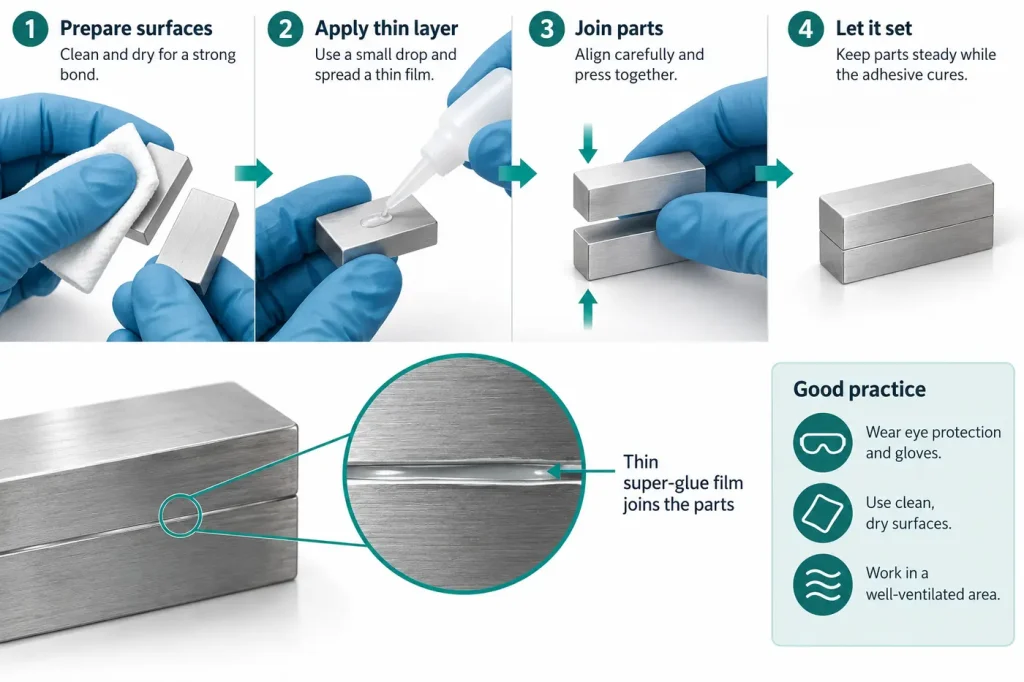
How can you get a reliable result?
- Remove failed adhesive where practical and dry-fit the pieces; clamp or tape the alignment before applying fresh glue.
- Clean the contact area without leaving soap, polish or solvent residue. Use only preparation approved for the substrate.
- Apply a thin layer to a compatible close-fit joint, then press the pieces together without sliding them repeatedly.
- Leave the joint undisturbed until the specific adhesive reaches full cure; fast handling strength is not maximum service strength.
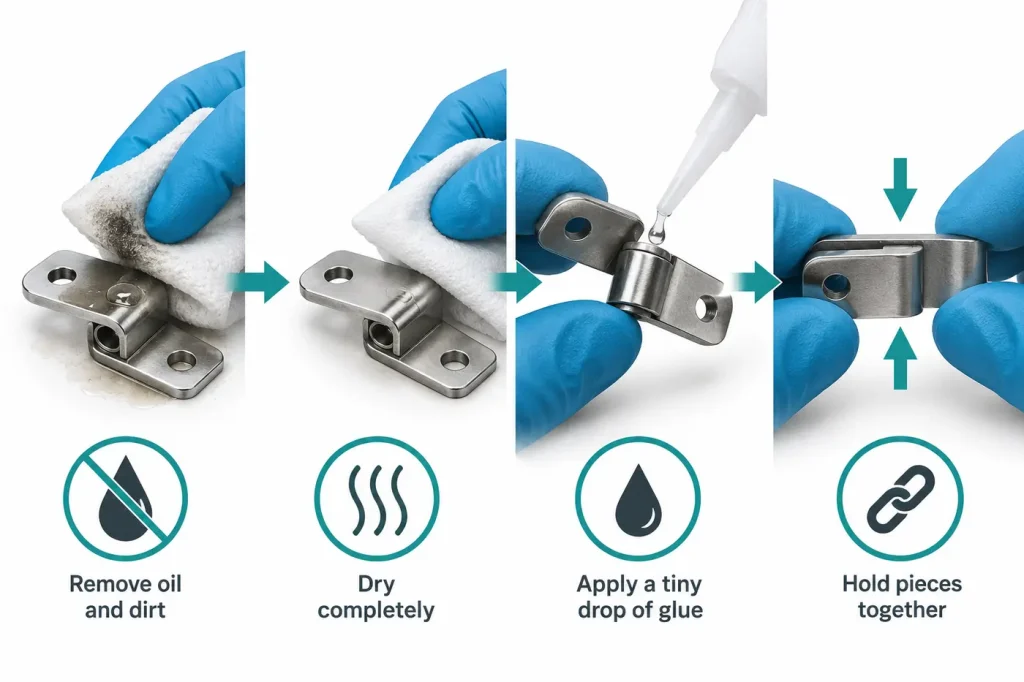
What are the limits and common failure signs?
Baking soda can make cyanoacrylate harden rapidly and create a filled mass, but it does not establish a stronger engineered bond. The reaction can release heat. Keep cyanoacrylate off cotton or wool and avoid flooding a joint or combining random accelerators.
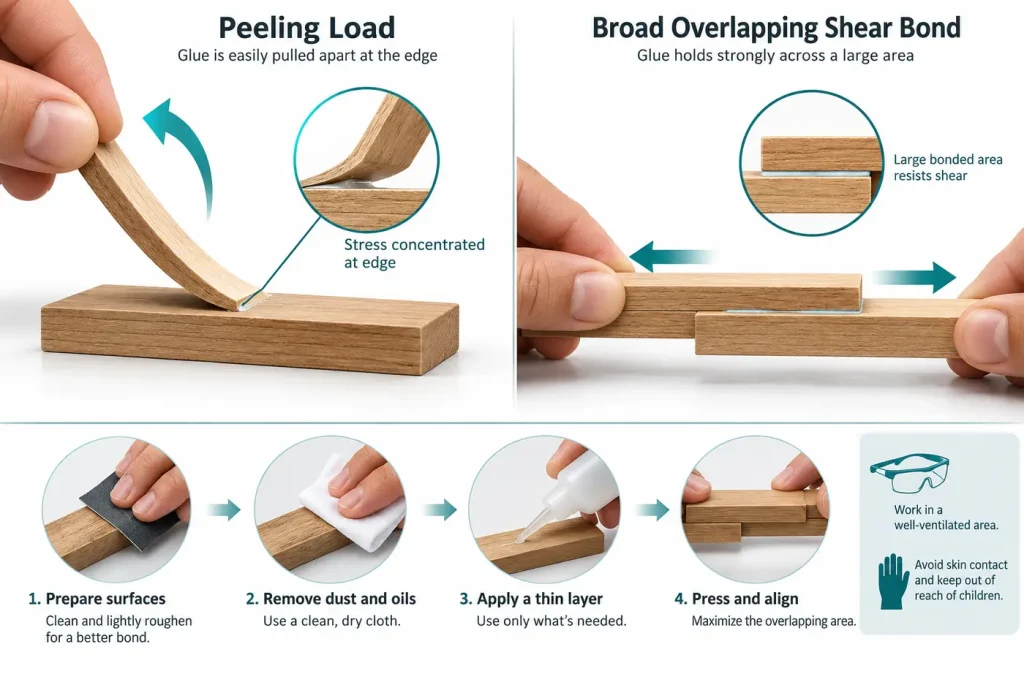
A break that starts at one edge often indicates peeling stress. Increase overlap, add mechanical support or reposition the load so it acts across the bond area. A thicker puddle cannot correct a joint that continually pries itself apart.
More practical questions
Should I wet the surfaces?
Do not soak a super-glue joint to accelerate curing. Cyanoacrylate normally reacts with surface moisture, but extra water can interfere with the joint. Follow the product directions; the dampening instruction for original polyurethane Gorilla Glue should not be transferred to super glue.
Will an accelerator increase strength?
An approved accelerator may shorten curing time, but speed and final strength are separate properties. Check the glue manufacturer’s guidance and test on matching material. Accelerated curing is especially unsuitable as a substitute for proper cleaning, a close fit or sufficient curing time.
Manufacturer documentation and selection notes
Use the current label and technical sheet for the exact formulation. Generic comparisons do not override product-specific substrate, curing or service instructions.