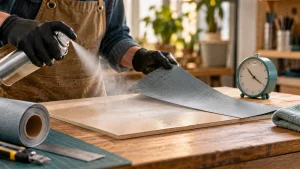
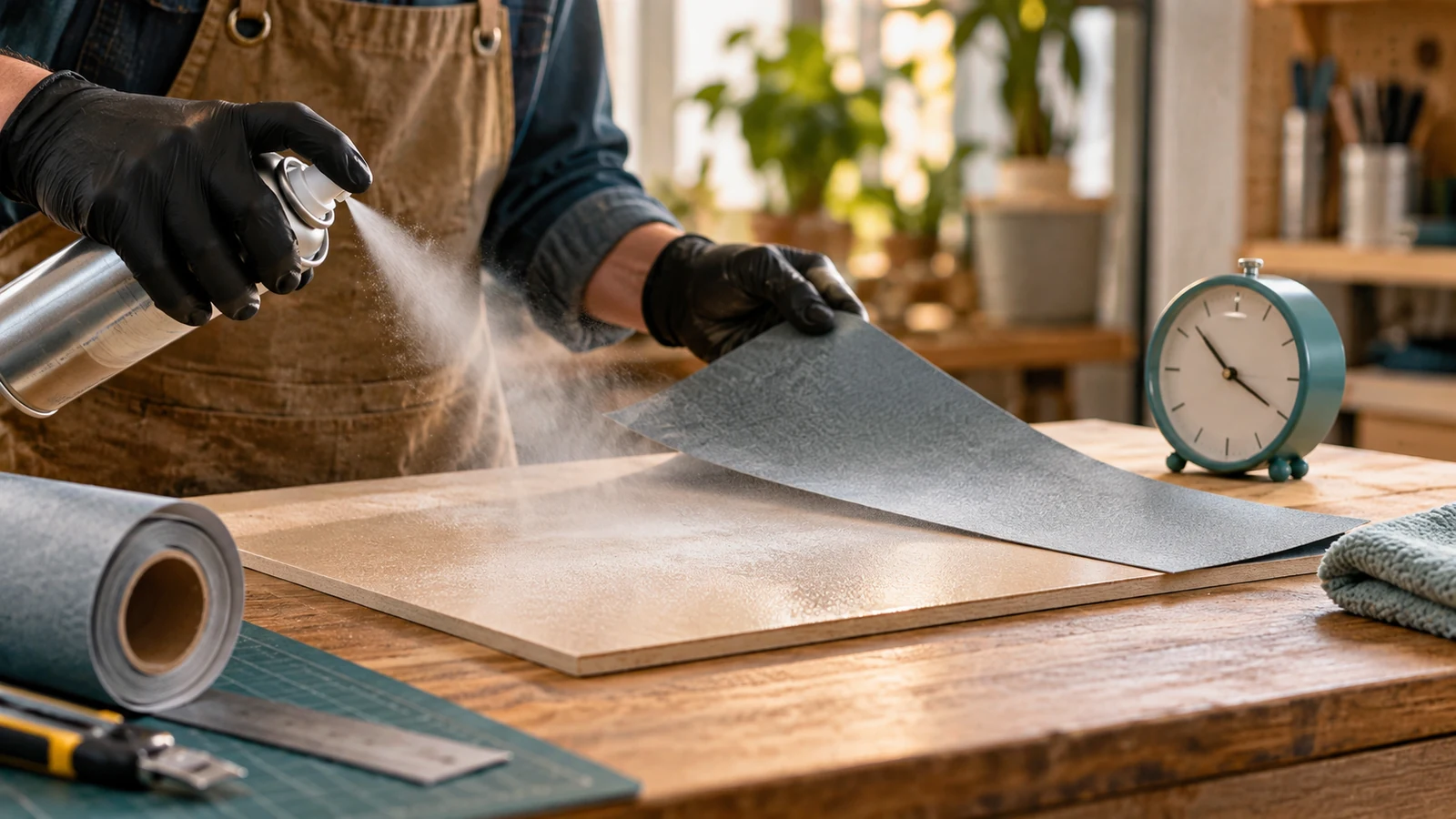
Spray adhesive usually reaches bonding tack in 15 seconds to 4 minutes, becomes dry to the touch in 10-30 minutes, and reaches full bond strength after about 24 hours. Solvent type, coating thickness, material porosity, temperature, humidity, ventilation, and the specific product can shorten or extend each stage.
Key Facts at a Glance
Spray adhesive typically becomes bondable after 15 seconds to 4 minutes, when the film feels aggressively tacky rather than wet.
A joined spray-adhesive bond commonly becomes handleable after 10-30 minutes.
Permanent applications should normally remain undisturbed for 24 hours before heavy loading.
Thick coats dry more slowly and can trap solvent between nonporous surfaces.
Porous materials such as paper and fabric absorb adhesive, while metal and plastic can retain solvent on the surface.
Product instructions control the final timing because rubber, acrylic, contact, and repositionable adhesives behave differently.
How Long Does Spray Adhesive Take to Dry?
For most permanent aerosol adhesives, expect 15-240 seconds to reach tack, 10-30 minutes to set after joining, and approximately 24 hours to cure. “Dry” does not describe one moment: a surface can feel dry while the bond remains too weak for stretching, lifting, vibration, heat, or moisture.
The label may use different terms. Open time is the period during which the sprayed film remains usable. Tack time is the waiting period before surfaces should meet. Set time indicates initial holding power, while cure time is the period required for the adhesive to reach its intended final performance.
Spray Adhesive Drying Stages
| Stage | Typical time | Correct test | What the bond can withstand |
|---|---|---|---|
| Wet film | 0-15 seconds | Visible shine or transfer | No contact or handling |
| Tack stage | 15 seconds-4 minutes | Knuckle test or light fingertip check | Surface joining |
| Initial set | 10-30 minutes | Edges remain aligned | Light handling |
| Functional cure | 2-6 hours | No soft movement under light pressure | Moderate handling |
| Full cure | About 24 hours | Firm, stable bond | Rated service load |
The time ranges are typical rather than universal. A product designed for instant contact bonding may require a longer open time than a general-purpose paper adhesive, while a repositionable mounting spray may intentionally remain tacky for hours.
Why Does Spray Adhesive Dry?
Spray adhesive dries because its carrier, usually a volatile solvent or water, evaporates and leaves a polymer film behind. The aerosol can atomizes the adhesive into small droplets, creating a thin layer with a large surface area for evaporation.
Solvent-based formulas often flash off quickly and develop tack within seconds. Water-based formulas can need more time because water evaporates more slowly, particularly in humid air. After the carrier leaves, the polymer film forms the working bond through pressure-sensitive adhesion, mechanical grip, or additional chemical curing.
The process changes when two nonporous surfaces meet too soon. The trapped solvent has fewer paths to escape, so bubbles, soft spots, edge lift, and persistent odor can develop beneath the joined materials.
Does Spray Adhesive Cure After It Feels Dry?
Yes. Spray adhesive may feel dry while residual solvent remains inside the film or substrate. A dry-feeling surface indicates that the top layer no longer transfers readily; it does not prove that the adhesive has reached maximum shear or peel strength.
A thin paper-to-cardboard bond may become useful within minutes. A laminate-to-metal panel, upholstered cushion, or large plastic sheet should normally receive the full manufacturer-specified cure period before stress is applied.
How Long Should Spray Adhesive Sit Before Bonding?
Allow spray adhesive to sit until the surface is tacky but no longer visibly wet, commonly 15 seconds to 4 minutes. The exact wait is printed on the can and depends on whether the adhesive is intended for wet bonding, pressure-sensitive bonding, or contact bonding.
Use the manufacturer’s stated open time first. If no time is given, apply a light test coat to scrap material and check it at 15-second intervals.
The Knuckle Test
Touch the adhesive film lightly with a clean knuckle rather than pressing a fingertip into it. The correct film feels aggressively sticky but does not leave liquid adhesive on the skin or pull into strings.
The test is useful, but it is not a substitute for the label. Some contact adhesives bond well while still slightly wet; some repositionable products remain sticky by design. Test a hidden area when the substrate is valuable, coated, dyed, or heat-sensitive.
Which Factors Change Spray Adhesive Drying Time?
Temperature, humidity, ventilation, coating thickness, and substrate porosity determine how quickly spray adhesive loses its carrier and develops strength. The same can may reach tack in 30 seconds on thin cardboard but require several minutes on a heavy, wet-looking coat applied to sealed plastic.
| Factor | Faster-drying condition | Slower-drying condition | Likely effect |
|---|---|---|---|
| Temperature | 18-35°C, 65-95°F | Below 10°C, 50°F | Delayed evaporation and weaker initial tack |
| Relative humidity | 30-50% | Above 70% | Longer water evaporation and possible condensation |
| Coat thickness | One thin, even pass | Multiple wet passes or puddling | Minutes to hours longer |
| Air movement | Cross-ventilation without dust | Still, enclosed air | Solvent remains near the surface |
| Substrate | Paper, cardboard, unfinished wood | Metal, glass, sealed plastic | Less absorption and slower release |
| Surface moisture | Completely dry material | Damp fabric or condensation | Poor adhesion and extended set time |
Warm air can accelerate evaporation, but excessive heat can create a skin on top of a wet layer, trapping solvent beneath it. Direct sunlight can also distort foam, fabric, plastic, or freshly painted surfaces. Moderate temperature and moving air are safer than aggressive heating.
Does Humidity Slow Spray Adhesive?
High humidity commonly slows water-based spray adhesive and can delay solvent release from a thick film. Humidity also creates a separate problem: moisture on the substrate can prevent the adhesive from making continuous contact.
Work on dry materials in a ventilated area. Avoid spraying when condensation is visible or when a cold panel has just been moved into warm, humid air. A dehumidified room at approximately 30-60% relative humidity is generally more predictable than a damp workshop.
How Long Does Spray Adhesive Take to Dry on Different Materials?
Material type changes timing because porous surfaces absorb part of the adhesive while sealed surfaces retain the film on top. Fabric, paper, and unfinished wood often become bondable quickly but may require a second light coat; plastic, metal, and laminated boards require careful solvent evaporation and firm pressure.
| Material or assembly | Typical tack wait | Typical handling time | Recommended heavy-load wait | Main risk |
|---|---|---|---|---|
| Paper to cardboard | 15-60 seconds | 5-15 minutes | 2-12 hours | Wrinkling or bleed-through |
| Fabric to foam | 30 seconds-3 minutes | 15-30 minutes | 24 hours | Stiff spots and solvent odor |
| Fabric to fabric | 30 seconds-3 minutes | 15-30 minutes | 24 hours | Uneven saturation |
| Wood or MDF veneer | 1-4 minutes | 20-30 minutes | 24 hours | Curling and edge lift |
| Metal to laminate | 1-4 minutes | 20-30 minutes | 24-48 hours | Trapped solvent |
| ABS or rigid plastic | 30 seconds-3 minutes | 15-30 minutes | 24 hours | Stress cracking or poor wetting |
| EPS foam | 1-5 minutes | 20-45 minutes | 24 hours | Solvent melting |
How Long Does Spray Adhesive Take to Dry on Fabric?
Spray adhesive on fabric commonly reaches usable tack in 30 seconds to 3 minutes, sets in 15-30 minutes, and should cure for 24 hours before washing, stretching, or upholstery use. Lightweight fabric can absorb a light coat rapidly, while thick fleece and multilayer textiles retain solvent longer.
Spray from approximately 20-25 centimetres, or 8-10 inches, away. Keep the can moving and use a fine, even pass. A heavy coat can bleed through fabric, create a rigid patch, or remain tacky under the top fibers.
Can Spray Adhesive Be Used on Styrofoam?
Only use spray adhesive explicitly labeled safe for expanded polystyrene, commonly called EPS or Styrofoam. Many solvent-based aerosols attack foam and create craters, shrinkage, or complete surface collapse.
Test a hidden piece before production work. A product that is safe for foam may still require 1-5 minutes of open time because the porous surface absorbs the adhesive while the carrier evaporates.
Which Type of Spray Adhesive Dries Fastest?
General-purpose rubber-based spray adhesive usually reaches tack fastest, often in 15-30 seconds, while water-based or acrylic formulas may require 4-5 minutes. Fast tack is not the same as the strongest or most durable bond.
| Adhesive type | Tack time | Set or handling time | Full cure | Typical applications |
|---|---|---|---|---|
| Rubber-based multipurpose | 15-30 seconds | 10-15 minutes | 24 hours | Paper, cardboard, fabric, foil |
| High-strength contact spray | 1-2 minutes | 20-30 minutes | 24 hours | Wood, laminate, leather, metal |
| Repositionable mounting spray | 15-60 seconds | Remains workable up to 12 hours | Product-dependent | Stencils, layouts, patterns |
| Acrylic or water-based | 4-5 minutes | 20-45 minutes | 24-48 hours | Canvas, selected plastics, foam-safe work |
Fast products reduce waiting but also reduce correction time. A high-strength contact spray can grab before a large panel is correctly aligned, so dry-fitting and using temporary registration marks matter more than speed.
Is Repositionable Spray Adhesive Supposed to Stay Sticky?
Yes. Repositionable spray adhesive is designed to retain pressure-sensitive tack rather than become a hard, permanent film immediately. That behavior allows a stencil, pattern, or display graphic to be peeled away and adjusted.
Repositionable adhesive is not suitable for structural loads, permanent upholstery seams, heavy trim, or outdoor panels unless the product label specifically permits those uses. Long exposure can also leave residue or make removal more difficult.
How Do You Apply Spray Adhesive for the Shortest Reliable Dry Time?
Apply one thin, uniform coat to clean, dry surfaces, wait until the film reaches the specified tack, then join the pieces with firm, even pressure. Correct spray distance and coat thickness usually matter more than trying to heat the adhesive.
- Prepare the materials. Remove dust, grease, loose fibers, and moisture. Mask adjacent areas and test compatibility on scrap.
- Ventilate the work area. Work outdoors or in a space designed for aerosol use, away from flames, sparks, heaters, and ignition sources.
- Shake the can. Follow the label, commonly for 30-60 seconds, so solids and propellant are evenly distributed.
- Hold the can 8-10 inches away. Spray while moving continuously across the surface rather than stopping over one point.
- Apply a thin coat. Overlap passes slightly; do not create glossy puddles or saturated edges.
- Wait for tack. Use the product’s stated open time, then perform a light knuckle test in an inconspicuous area.
- Join accurately. Bring the surfaces together without sliding them, especially with contact adhesive.
- Apply pressure. Use a roller, clean block, or hand pressure for 30-60 seconds, subject to the substrate.
- Support the assembly. Keep the bond flat and undisturbed for at least 10-30 minutes.
- Allow full cure. Wait 24 hours before heavy load, washing, flexing, outdoor exposure, or high-temperature service.
What Is the Most Common Application Mistake?
The most common mistake is applying too much adhesive and joining the surfaces while the film is still wet. Heavy application feels stronger because it produces a glossy, continuous layer, but the trapped carrier can leave a soft bond that fails later.
A second coat should be thin and intentional. On porous fabric or unfinished wood, a light first coat may be absorbed; allow it to flash off before adding another coat if the label permits.
Why Is Spray Adhesive Still Sticky After 24 Hours?
Spray adhesive can remain sticky after 24 hours because the coat was too thick, the room was cold or humid, the surfaces were nonporous, the product is repositionable, or the adhesive is incompatible with the substrate. Persistent tack does not always mean failure, but soft transfer under light pressure indicates incomplete drying.
| Symptom | Likely cause | Immediate response | Long-term correction |
|---|---|---|---|
| Wet or glossy film | Excess adhesive | Separate if possible and ventilate | Apply thinner passes |
| Bubbles beneath panel | Joined before tack | Lift and reapply if materials permit | Extend flash-off time |
| Edge lift | Dust, low pressure, or wrong adhesive | Press and clamp temporarily | Clean and select compatible formula |
| Bleed-through on fabric | Saturated textile | Blot only if product allows | Use lighter coats and masking |
| Foam melting | Solvent incompatibility | Stop and remove damaged foam | Use foam-safe adhesive |
| Uneven spray | Partly clogged nozzle | Clear nozzle safely | Purge nozzle after use |
| Weak bond on plastic | Low surface energy or contamination | Clean and retest | Use labeled plastic-compatible product |
Do not add a fan that blows solvent toward an ignition source, and do not use a heat gun to force drying. Aerosol propellants and many adhesive solvents are flammable.
Can You Fix a Wet Spray-Adhesive Bond?
If the materials can be separated without tearing, separate them while the adhesive remains workable, place them in a ventilated area, and follow the product’s cleanup instructions. Isopropyl alcohol or mineral spirits may damage paint, plastic, foam, or fabric, so test the cleaning agent first.
For a failed permanent bond, removal and reapplication usually outperform pressing harder. Scrape cured residue only with a tool that will not gouge the substrate, then clean, dry, and apply a thin fresh coat.
How Do You Prevent a Spray-Adhesive Nozzle From Clogging?
Clear the nozzle immediately after use according to the manufacturer’s instructions. Many aerosol products can be purged by turning the can upside down and spraying for approximately 2 seconds until clear propellant exits, but the label takes priority.
| Maintenance action | Typical frequency | Useful result | Avoid |
|---|---|---|---|
| Wipe the nozzle tip | After every session | Removes wet residue | Touching the spray opening with a pin |
| Purge inverted can | After compatible products | Clears internal adhesive | Purging near flame or face |
| Replace damaged nozzle | When spray sputters | Restores even pattern | Continuing with large droplets |
| Store upright | Every storage period | Limits valve leakage | Leaving can in a hot vehicle |
Store aerosol adhesive in a cool, dry place within the temperature range on the label. Do not puncture, burn, freeze, or expose the can above its stated storage temperature.
Spray Adhesive Compared With Other Adhesives
Spray adhesive is best when a large, thin area needs fast, even coverage. It is usually a poor choice for narrow structural joints, submerged assemblies, heavy load-bearing repairs, or surfaces that require gap filling.
| Adhesive option | Typical working time | Typical cure time | Best use | Main limitation |
|---|---|---|---|---|
| Spray adhesive | 15 seconds-4 minutes | 24 hours | Large-area laminating and fabric | Overspray and limited gap filling |
| PVA wood glue | 5-10 minutes | 24 hours | Porous wood and paper | Requires clamping and does not suit many plastics |
| Contact cement | 5-20 minutes open time | 24-72 hours | Laminate and broad nonporous surfaces | Little correction after contact |
| Cyanoacrylate | 5-60 seconds | 1-24 hours | Small rigid repairs | Brittle joints and poor gap filling |
| Two-part epoxy | 5-60 minutes | 24-72 hours | Structural, gap-filling bonds | Mixing, cleanup, and longer handling |
| Hot-melt glue | 10-60 seconds | 1-10 minutes | Temporary craft assembly | Softens under heat and carries limited load |
The correct alternative depends on joint geometry and service conditions. A spray adhesive can cover a large fabric panel efficiently, but epoxy or mechanical fasteners are more appropriate when the joint must carry concentrated force.
How Much Does Spray Adhesive Cost?
Typical consumer spray adhesive costs approximately $10-$22 per 300-500 gram can, while specialty foam-safe, industrial, and repositionable products can cost more. Coverage, solids content, required coats, and failure risk matter more than the shelf price alone.
| Product category | Typical can price | Typical coverage range | Typical purchase reason |
|---|---|---|---|
| General-purpose rubber spray | $10-$15 | 10-25 square feet | Paper, cardboard, light fabric |
| High-strength contact spray | $15-$22 | 15-30 square feet | Laminate, wood, leather, metal |
| Repositionable mounting spray | $13-$18 | 20-40 square feet | Stencils and temporary layouts |
| Foam-safe acrylic or water-based | $12-$20 | 10-25 square feet | EPS, canvas, selected plastics |
| Industrial aerosol adhesive | $20-$35 | 20-50 square feet | Repeated production work |
Coverage varies sharply with spray distance and coat thickness. A user who applies two heavy coats may consume twice as much adhesive while obtaining a weaker, slower-drying bond.
What Safety Precautions Matter During Drying?
Use spray adhesive with strong ventilation, eye protection, and no ignition sources because many aerosol formulas release flammable vapors. Read the Safety Data Sheet when working indoors, using large quantities, or applying adhesive near occupied spaces.
Keep the can away from children, heat, sparks, and direct sunlight. Do not spray on skin, near food-contact surfaces, or inside an unventilated vehicle. If the label requires respiratory protection, follow the stated cartridge and fit requirements rather than substituting a simple dust mask.
The 24-hour cure period does not automatically mean the odor has disappeared. Continue ventilation until the product’s solvent odor has cleared and the label permits normal occupancy or use.
FAQ
Can You Use Spray Adhesive in Cold Weather?
Spray adhesive can work in cold weather, but low temperature slows evaporation, reduces spray quality, and weakens early tack. Bring both the can and materials into the label’s operating range, commonly around 18-35°C, before application. Do not warm an aerosol can with a flame, heater, oven, or hot water.
Can You Paint Over Spray Adhesive?
Paint only after the adhesive has fully cured and the product label confirms paint compatibility. A still-soft adhesive film can wrinkle, repel water-based paint, or transfer into the coating. Test a cured sample first, particularly when the substrate is plastic, foam, vinyl, or a factory-finished laminate.
How Long Should Spray Adhesive Dry Before Cutting Fabric?
Allow fabric adhesive to become tack-free or stable for at least 15-30 minutes before careful cutting, then wait approximately 24 hours before washing, ironing, stretching, or sewing a heavily stressed seam. Light fabric can shift under scissors if the adhesive has not set evenly.
Does Spray Adhesive Wash Out of Clothing?
Many permanent spray adhesives do not wash out cleanly after curing. Treat fresh residue according to the manufacturer’s cleanup directions, test any solvent on an inside seam, and avoid heat until the residue is removed because a dryer can set the adhesive more firmly.
Does Spray Adhesive Work Outdoors?
Some spray adhesives are rated for outdoor exposure, but others soften under ultraviolet light, rain, temperature cycling, or high heat. Check the product’s water, UV, and temperature ratings, then allow the full cure period before exposure. For permanent exterior loads, mechanical fastening may be more reliable.
Can You Apply a Second Coat of Spray Adhesive?
A second coat can improve coverage on porous material when the product permits it, but the first coat should flash off before the second application. Wait until the surface is tacky rather than wet, and use a thinner second pass to avoid trapping solvent or creating a rigid layer.
The Bottom Line
Spray adhesive typically takes 15 seconds to 4 minutes to reach bonding tack, 10-30 minutes to set for light handling, and about 24 hours to cure fully. The exact answer depends on the adhesive chemistry, coat thickness, surface porosity, temperature, humidity, ventilation, and load.
For reliable results, spray a thin coat from 8-10 inches away, wait until the film passes the knuckle test, join the surfaces without sliding, apply even pressure, and postpone heavy stress until the full cure period has passed. Therefore, the practical answer to how long does spray adhesive take to dry is: wait minutes before joining, half an hour before light handling, and a full day before demanding maximum performance.