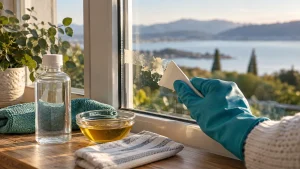
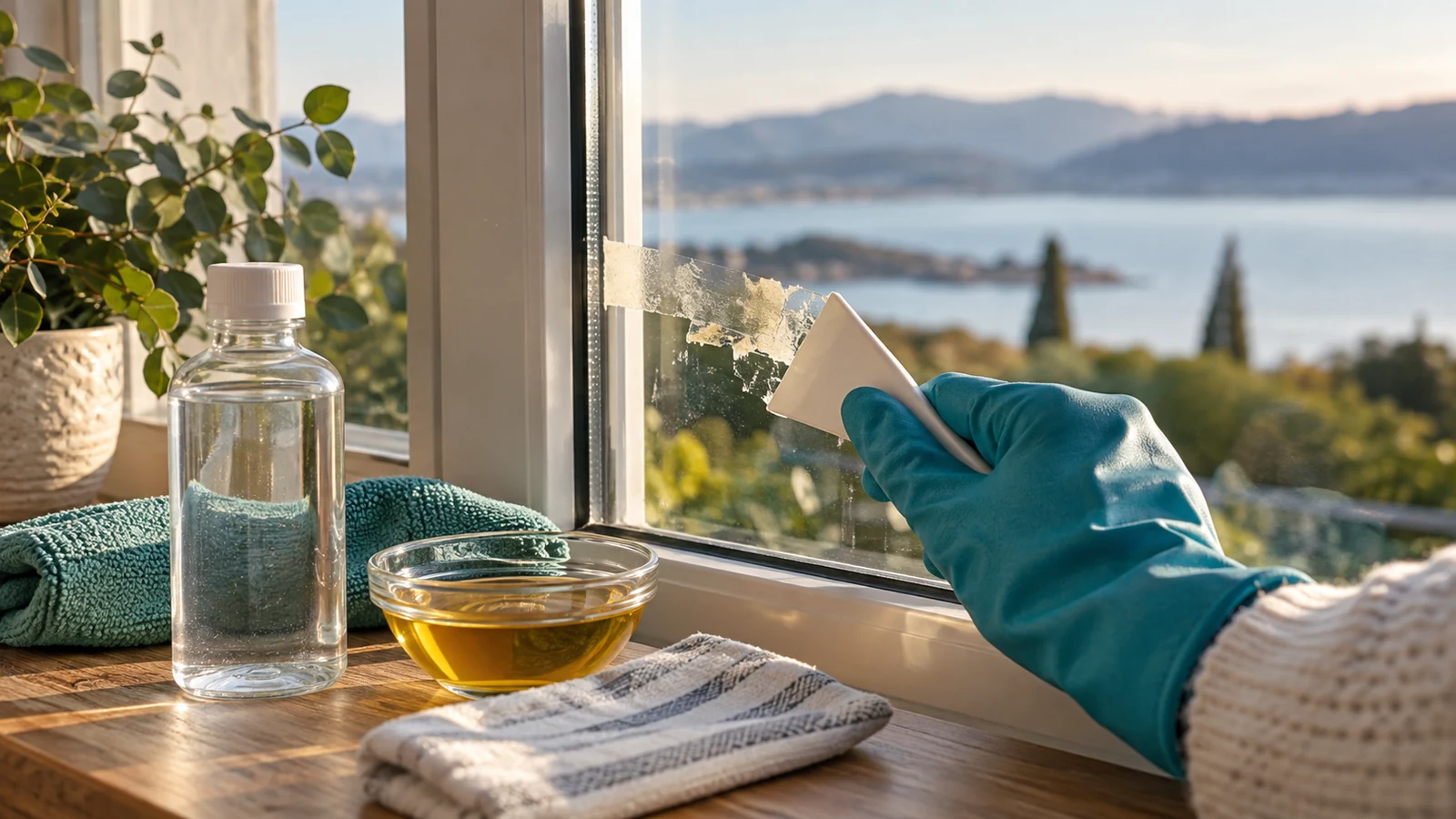
To remove tape residue from glass, soften the adhesive with cooking oil, isopropyl alcohol, or a commercial adhesive remover, then lift it with a lubricated scraper and wash away the remaining film. Light residue usually takes 5-15 minutes; old, hardened adhesive may require gentle heat and two treatment cycles.
Key Facts
Isopropyl alcohol is usually effective on fresh, thin adhesive residue from masking or packing tape.
Cooking oil softens many rubber-based adhesives but requires dish soap afterward to remove the greasy film.
A clean single-edge razor is safe on ordinary, uncoated glass when kept wet and held at roughly 30-45 degrees.
Acetone can damage plastic frames, window films, painted surfaces, sealants, and some glass coatings.
Dry scraping creates avoidable scratches because trapped grit can move beneath the blade.
Most household jobs cost less than $10 and take 5-30 minutes, depending on adhesive age and area.
What Makes Tape Residue Stick to Glass?
Tape residue is a pressure-sensitive adhesive film made from polymers, tackifying resins, plasticizers, and other additives. Glass is smooth and nonporous, so adhesive cannot soak into it, but the adhesive can spread across microscopic surface irregularities and form a strong contact bond.
Water alone rarely dissolves tape glue because many pressure-sensitive adhesives repel water. Window cleaner can loosen surface dirt while leaving the adhesive intact, which often creates a larger cloudy smear.
Sunlight and heat can change the residue. Ultraviolet exposure may harden or cross-link some adhesive components, while repeated heating and cooling can leave a brittle crust around the original tape edges. Fresh residue is generally easier to remove than residue left for weeks.
Does the tape type change the method?
Yes. Masking tape and paper label adhesive usually respond to warm water, oil, or alcohol. Packing tape, duct tape, mounting tape, and foam tape often need solvent plus mechanical lifting because their rubber or acrylic adhesives are thicker and more cohesive.
| Tape type | Typical residue | First method | Typical time |
|---|---|---|---|
| Masking tape | Thin, soft film | Isopropyl alcohol | 5-10 minutes |
| Clear packing tape | Sticky transparent layer | Oil or alcohol | 10-15 minutes |
| Duct tape | Dark, rubbery residue | Oil plus scraper | 15-25 minutes |
| Foam mounting tape | Thick acrylic layer | Heat plus scraper | 20-40 minutes |
| Label sticker | Paper and glue | Warm water, then alcohol | 10-20 minutes |
What Should You Use to Remove Tape Glue?
The best remover depends on the adhesive, nearby materials, and whether the glass has a film or coating. Use isopropyl alcohol for light residue, cooking oil for a low-risk first attempt on bare glass, and a commercial citrus or petroleum-based remover for thick residue that survives both methods.
| Remover | Best use | Contact time | Main limitation |
|---|---|---|---|
| Isopropyl alcohol, 70-91% | Fresh or thin glue | 30-120 seconds | May struggle with thick cured adhesive |
| Vegetable or baby oil | Rubber-based residue | 10-30 minutes | Leaves an oily film |
| Citrus adhesive remover | Heavy residue on bare glass | 2-10 minutes | Requires ventilation and degreasing |
| WD-40 | Stubborn rubbery residue | 2-5 minutes | Oily; keep away from films and sealants |
| Acetone | Small areas of bare glass | 15-60 seconds | Damages plastic, tint, paint, and some coatings |
| White vinegar | Light residue and final mineral cleaning | 5-10 minutes | Weak against cured adhesive |
Is rubbing alcohol better than oil?
Rubbing alcohol is faster on light residue, while oil is gentler and often more effective against thick rubber-based glue. Alcohol evaporates cleanly, but oil penetrates sticky adhesive for longer; the trade-off is that oil requires a detergent wash before the glass becomes streak-free.
Do not pour either liquid directly onto a window edge, electronics, or a framed panel. Apply a small amount to a cloth or folded paper towel so the liquid stays on the adhesive rather than entering a frame, gasket, speaker opening, or switch.
Before You Start
Prepare the surface and materials before applying solvent. A controlled setup prevents the two most common failures: spreading softened adhesive over a larger area and scratching glass with a contaminated blade.
| Requirement | Typical specification | Quantity |
|---|---|---|
| Microfiber cloth | Clean, lint-free, 30 x 30 cm | 2 |
| Isopropyl alcohol | 70% or 91% solution | 10-20 mL |
| Dish soap | Standard liquid detergent | 2-5 mL |
| Single-edge razor | New, clean, unchipped blade | 1 |
| Spray bottle | Warm water with soap | 250 mL |
| Hairdryer | Low or medium setting | 1 |
Work in ventilation when using alcohol, citrus remover, WD-40, or acetone. Wear nitrile gloves for commercial solvents, keep all products away from flames, and test an inconspicuous corner if the glass has tint, paint, printed markings, or a factory coating.
How to Remove Tape Residue From Glass
The safest general process has seven steps and usually takes 10-20 minutes for a hand-sized patch. The key factor is lubrication: keep the glass wet while scraping, because a dry blade and trapped grit can permanently mark the surface.
Step 1: Remove Loose Tape and Dirt
Peel away remaining tape slowly at a low angle, then wipe loose grit from the glass with a dry microfiber cloth. Pulling the tape back over itself at approximately 180 degrees reduces the upward force applied to the surface and often removes more adhesive with the tape.
Do not begin scraping while dust or sand remains on the glass. Abrasive particles under a blade can create fine lines even when the blade itself is clean.
You will know it worked when: only a defined adhesive patch remains.
Common mistake: pulling rapidly upward and leaving a thick edge of glue.
Step 2: Soften the Adhesive
Apply 5-10 mL of isopropyl alcohol to a cloth and press it against the residue for 30-60 seconds. For thick rubbery residue, spread a thin layer of vegetable or baby oil over the patch and wait 10-20 minutes.
Use a hairdryer on low or medium heat for 30-60 seconds when the residue is brittle or heavily sun-baked. Keep the dryer moving and approximately 15-20 cm from the surface. Warm glass should remain comfortably touchable, not hot.
You will know it worked when: the adhesive becomes glossy, softer, or easier to mark with a fingernail.
Common mistake: applying high heat to one spot, which can stress glass or damage nearby plastic.
Step 3: Scrape the Softened Residue
Spray the area with soapy water or keep it lightly coated with the chosen remover. Hold a new single-edge razor at roughly 30-45 degrees, keep the blade nearly flat, and push in one direction with short, controlled strokes.
Use a plastic scraper on coated, tinted, frosted, or uncertain surfaces unless the manufacturer permits a metal blade. Replace the blade if it catches, skips, or shows corrosion.
You will know it worked when: adhesive gathers into narrow rolls or flakes instead of smearing.
Common mistake: using a dry razor or changing direction aggressively over the same patch.
Step 4: Apply the Correct Dissolver
Use alcohol for the remaining thin film. Use oil or a commercial adhesive remover for thick, gummy residue, following the product label rather than assuming that a longer dwell time is safer.
Covering a solvent-dampened cloth with plastic film for 2-5 minutes can slow evaporation on a small, bare-glass patch. Remove the cover before scraping, and never seal volatile solvent against a coated surface or an unventilated room.
You will know it worked when: a clean cloth picks up translucent adhesive rather than leaving a tacky trail.
Common mistake: repeatedly wiping with the same dirty section of cloth, which redistributes glue.
Step 5: Wipe in One Direction
Fold a microfiber cloth into a clean quarter and wipe from the outside edge toward the center. Rotate to an unused section after each pass, then repeat with a second cloth lightly dampened with alcohol or the compatible remover.
Circular rubbing often spreads dissolved adhesive into a haze. Straight, overlapping passes concentrate the residue and make the remaining patch easier to identify.
You will know it worked when: the glass feels smooth when checked with a clean fingertip.
Common mistake: judging the surface while it is still wet, when solvent haze can hide residual glue.
Step 6: Degrease the Glass
Mix approximately 2-5 mL of dish soap into 250 mL of warm water. Wash the treated area, rinse with clean water, and dry with a fresh microfiber cloth.
This step is mandatory after oil, WD-40, or petroleum-based remover. Alcohol-only treatments may need only a water wash, but soap remains useful if a faint smear or oily edge is visible.
You will know it worked when: water forms an even sheet or small consistent beads without a greasy boundary.
Common mistake: using more detergent than necessary and leaving a new surfactant film.
Step 7: Inspect Under Angled Light
Shine a flashlight across the glass at a shallow angle and inspect from several directions. Angled light reveals a thin adhesive haze that ordinary front lighting can miss.
Repeat only the smallest necessary section. A second 2-minute alcohol treatment is safer than applying a stronger solvent across the entire pane.
You will know it worked when: the surface has no tack, edge halo, or smeared reflection.
Common mistake: polishing harder instead of identifying whether the remaining mark is glue, mineral scale, or a scratch.
Which Removal Method Fits Your Glass?
Choose the least aggressive method that can dissolve the residue. Bare architectural glass permits more mechanical and solvent options than tinted automotive glass, mirror backing, shower coatings, or glass with a plastic frame.
| Situation | Recommended sequence | Avoid | Typical duration |
|---|---|---|---|
| Bare window glass | Alcohol, lubricated razor, soap | Dry scraping | 5-15 minutes |
| Old duct tape residue | Heat, oil, razor, soap | Immediate acetone flooding | 15-30 minutes |
| Tinted car window | Oil or label-approved cleaner, plastic scraper | Razor on film | 10-25 minutes |
| Mirror face | Alcohol on cloth, plastic scraper | Liquid at edges | 5-15 minutes |
| Frosted or etched glass | Manufacturer-approved cleaner, plastic scraper | Metal razor and abrasives | 10-25 minutes |
| Glass with uPVC frame | Alcohol on cloth, careful wiping | Acetone and strong solvents | 5-20 minutes |
Can you use a razor on a window?
A razor is appropriate only for ordinary, uncoated glass and only when the surface is lubricated, the blade is clean, and the edge remains at a shallow angle. A razor can cut window film, scratch coatings, damage printed surfaces, or mark soft plastic frames.
Never scrape across a chipped edge, deep crack, silicone bead, or painted border. On uncertain glass, begin with a plastic card or plastic razor and stop if the surface coating changes appearance.
How do you remove tape from tinted glass?
Treat tinted glass as a coated surface, even when the tint is difficult to see. Use a small amount of oil or a cleaner specifically labeled for window film, allow brief softening, and lift residue with a plastic scraper or microfiber cloth.
Do not use acetone, ammonia-based cleaner, abrasive pads, or a metal razor on tint. Solvent can attack the film’s adhesive or create a discolored patch that cannot be polished away.
Common Mistakes and How to Fix Them
Most failed attempts result from excessive force, incompatible solvent, or incomplete degreasing. The recovery method should become milder, not more aggressive, until the material around the glass has been identified.
| Failure | Likely cause | Recovery action | Avoid next time |
|---|---|---|---|
| Glue spreads into a haze | Too much solvent or dirty cloth | Add fresh cloth sections, then soap-wash | Circular wiping |
| Fine scratches appear | Dry scraping or trapped grit | Stop scraping; assess under angled light | Use wet, clean tools |
| Frame turns soft or cloudy | Acetone or strong solvent contact | Wipe immediately with water and soap | Solvent near plastic |
| Glass remains greasy | Oil or WD-40 not degreased | Wash twice with diluted dish soap | Glass cleaner alone |
| Residue will not soften | Adhesive is cured or acrylic | Use controlled heat, then commercial remover | Repeated force |
| Dark mark remains | Transfer from duct tape backing | Test alcohol, then compatible remover | Assume every mark is glue |
A scratch cannot be dissolved with alcohol or polished away safely using household products. If a mark catches a fingernail, stop chemical treatment and consider professional glass polishing or replacement.
Time, Cost, and Quantity Guide
Typical household costs vary by country and brand, but the material quantities are small. A basic alcohol, cloth, soap, and plastic scraper setup commonly costs about $5-$15, while a specialist remover adds approximately $6-$15.
| Job size | Adhesive age | Product quantity | Typical time | Typical material cost |
|---|---|---|---|---|
| 5 cm label patch | Less than 1 week | 5 mL remover | 5-10 minutes | $0.25-$1 |
| 15 cm tape strip | 1-8 weeks | 10 mL remover | 10-20 minutes | $0.50-$2 |
| 30 cm duct-tape patch | Several months | 20-30 mL remover | 20-35 minutes | $1-$4 |
| Large window section | More than 1 year | 50-100 mL remover | 30-60 minutes | $3-$10 |
Alternatives and Special Cases
Does vinegar remove tape residue?
White vinegar can loosen light adhesive and remove mineral haze, but it is weaker than alcohol, oil, or a dedicated adhesive remover against cured tape glue. Apply it for 5-10 minutes, scrape only with a plastic tool if the surface is uncertain, and wash with soapy water afterward.
Vinegar is useful when the residue is mixed with hard-water deposits. It is not a reliable first choice for thick duct tape, foam mounting tape, or sun-baked acrylic adhesive.
Can hand sanitizer remove tape glue?
Hand sanitizer may remove a small fresh patch because many formulations contain alcohol, commonly around 60% or more, but gels can leave glycerin, carbomer, fragrance, or emollient residue. Use it only as a small emergency treatment, then wash the glass thoroughly with dish soap.
Can you use acetone?
Acetone can dissolve some adhesive rapidly on small areas of bare, uncoated glass, but it is a poor default choice. Acetone can soften uPVC, acrylic, polycarbonate, paint, rubber seals, laminated films, and printed coatings, and its vapors require strong ventilation.
If acetone is appropriate, apply a few drops to a cloth rather than pouring it onto the surface. Keep it away from frames and edges, use a short 15-60 second contact time, and wash the area immediately afterward.
FAQ
Will glass cleaner remove tape residue?
Glass cleaner may remove fingerprints and loose surface dirt, but it usually does not dissolve pressure-sensitive adhesive. Use alcohol, oil, or a compatible adhesive remover first, then use glass cleaner only after the residue and oily film have been removed.
How do you remove a sticker without leaving glue?
Warm the sticker with a hairdryer on low for 30-60 seconds, peel it back slowly, and treat the remaining glue with alcohol or oil. A plastic scraper reduces the risk of scratching when the sticker has been exposed to sunlight.
Is WD-40 safe for glass?
WD-40 is generally compatible with bare glass but should not be allowed to contact plastic frames, rubber seals, window tint, or specialty coatings. Apply it to a cloth, use a short 2-5 minute dwell time, and degrease the glass with dish soap afterward.
How do you remove tape residue from a mirror?
Use a small amount of alcohol on a cloth and keep liquid away from the mirror’s edges. Do not soak the back or perimeter, because moisture and solvents can reach the reflective backing and cause dark edge damage.
Why does tape residue return after cleaning?
Residue appears to return when a thin adhesive film remains beneath an oily or solvent haze. Inspect under angled light, repeat a short dissolving treatment with a fresh cloth, and finish with diluted dish soap rather than more aggressive scraping.
What should you do if the glass is scratched?
Stop scraping and check whether the mark catches a fingernail. Household solvents cannot repair a scratch; shallow professional polishing may help, while deep scratches, chips, and cracks require an assessment from a glass specialist.
The Bottom Line
The safest way to remove tape residue from glass is to soften the adhesive, keep the surface lubricated, lift residue with a clean scraper or cloth, and degrease afterward. Start with alcohol for light glue and oil for thick rubbery residue, use heat only to warm hardened adhesive, and avoid acetone near frames, films, seals, and coatings. These controls make how to remove tape residue from glass a repeatable cleaning task rather than a trial-and-error solvent problem.