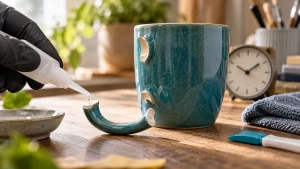
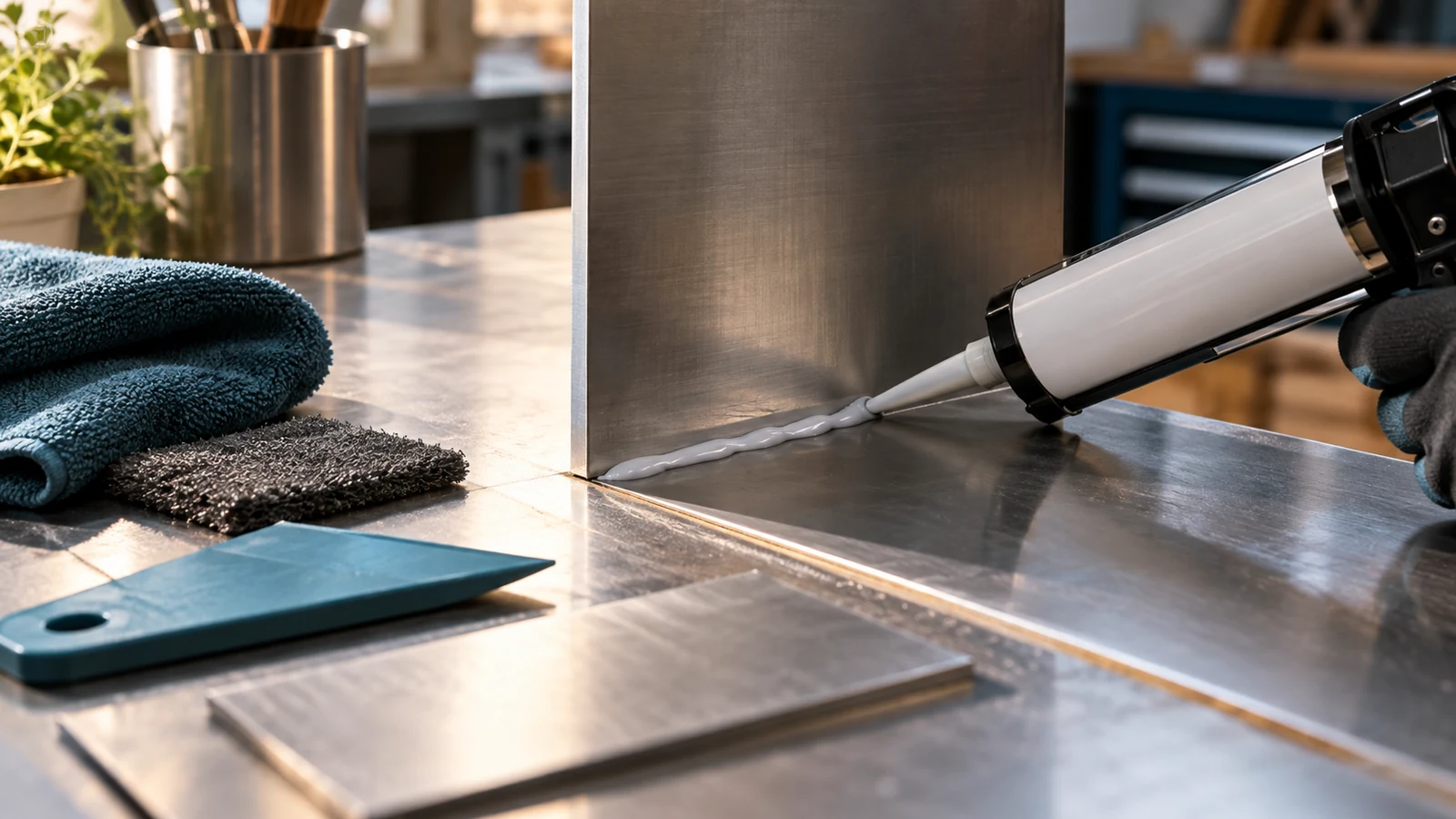
Silicone is a flexible polymer adhesive and sealant that can adhere to metal when the surface is clean, dry, suitably roughened, and paired with the correct cure chemistry. Neutral-cure silicone usually bonds aluminum, steel, stainless steel, and galvanized metal more safely than acid-cure silicone, but silicone is better for sealing and flexible joints than for heavily loaded structural connections.
Key Facts / Quick Answer
Silicone can adhere to metal, but adhesion depends on metal type, surface cleanliness, coating, and joint design.
Neutral-cure oxime or alkoxy silicone is the usual choice for bare metal; acetoxy silicone can corrode sensitive substrates.
Typical neutral silicone provides about 200-450 psi tensile strength and 350-600% elongation, but those figures do not make it a structural fastener.
A 2-3 mm bead commonly skins in 10-30 minutes and reaches an initial cure in about 24 hours.
Deep joints cure slowly because silicone needs atmospheric moisture, so a sealed metal sandwich can remain uncured at its center.
Consumer cartridges typically cost $7-$15; marine, industrial, and high-temperature products commonly cost $15-$30.
How Does Silicone Adhere to Metal?
Silicone adheres to metal through surface contact, chemical interaction with the metal’s oxide layer, and mechanical interlocking with microscopic scratches and irregularities. The liquid sealant wets the substrate before curing, then forms an elastic solid that can accommodate movement between materials with different thermal expansion rates.
Most common metals develop a thin oxide film in air. Aluminum forms aluminum oxide, steel forms iron oxides, and copper forms copper oxides. Silicone formulations contain reactive groups that can interact with these surface species, although the strength and durability of that interaction vary by formulation and contamination.
Mechanical adhesion matters just as much. Light abrasion increases available surface area and gives cured silicone shallow recesses to grip. Abrasion alone cannot rescue a surface covered with oil, wax, corrosion dust, fingerprints, or silicone residue.
Silicone also depends heavily on wetting. A bead that pulls away into rounded droplets has poor contact with the substrate. A bead that spreads smoothly across clean metal usually has a better starting condition, although visual wetting is not proof of a durable bond.
Adhesion Depends on the Interface, Not the Metal Alone
Bare metal is only one possible bonding surface. Paint, powder coating, anodizing, galvanizing, oxidation, and conversion coatings create separate interfaces with their own failure risks. In many repairs, the silicone bonds well to the coating while the coating itself releases from the metal.
A practical bond test should therefore pull the cured sealant from the actual finished surface, not from a clean sample of bare steel. Cut a small cured bead, grip the free end, and pull it back at a low angle. Cohesive tearing through the silicone is more encouraging than clean separation at the metal boundary.
Expert insight: A primer cannot convert loose rust or poorly bonded paint into a reliable substrate. Primer improves the silicone-to-surface interface; it does not repair failure beneath the surface.
Which Silicone Works Best on Metal?
Neutral-cure silicone is generally the safest starting point for metal because it releases non-acidic byproducts such as alcohol or oxime during cure. Acid-cure, also called acetoxy, silicone releases acetic acid and can attack susceptible metals or accelerate corrosion where moisture remains trapped.
Acid-Cure and Neutral-Cure Formulations
| Silicone type | Cure byproduct | Metal suitability | Typical use |
|---|---|---|---|
| Acetoxy silicone | Acetic acid, vinegar odor | Limited on copper, steel, iron, and some aluminum | Glass-to-glass sealing |
| Oxime neutral cure | Oxime compounds | Good general compatibility | Metal flashing, appliances, equipment |
| Alkoxy neutral cure | Alcohol | Good compatibility, low odor | HVAC, windows, coated metal |
| High-temperature silicone | Usually neutral or specialized chemistry | Depends on product data sheet | Engines, ovens, exhaust-adjacent parts |
| Marine silicone | Neutral or specialized chemistry | Good for wet exposure if specified | Boat fittings, deck hardware, glazing |
The word “neutral” is not enough by itself. Check the technical data sheet for listed substrates, primer requirements, corrosion behavior, and immersion limits. A product marketed for glass may have weaker metal adhesion than a construction, HVAC, automotive, or marine grade.
Acetoxy silicone is not guaranteed to destroy every metal immediately. The practical rule is narrower and safer: avoid it for corrosion-sensitive metal, enclosed metal joints, electrical assemblies, and applications where the manufacturer does not approve the substrate.
Metal Compatibility by Substrate
| Metal or finish | Typical adhesion without primer | Main risk | Recommended approach |
|---|---|---|---|
| Stainless steel | Medium to good | Oils and passive surface film | Degrease, abrade lightly, use neutral cure |
| Bare aluminum | Medium | Oxide layer and surface contamination | Abrade, solvent-clean, test primer |
| Galvanized steel | Medium | Zinc coating failure or chalking | Avoid aggressive abrasion, use approved primer |
| Carbon steel | Medium | Flash rust and corrosion | Remove rust, dry immediately, use neutral cure |
| Copper or brass | Variable | Oxidation and acetoxy attack | Use neutral cure and substrate primer |
| Anodized aluminum | Good if coating is sound | Coating damage or release | Clean gently and test adhesion |
| Powder-coated steel | Variable | Silicone bonds to weak coating | Test coating integrity first |
| Painted metal | Variable | Paint delamination | Sand only if compatible, test a hidden area |
Stainless steel often looks clean while retaining machining oil or polishing compound. Degreasing is more important than aggressive sanding because deep scratches can remain visible and may damage a finished surface.
Galvanized steel requires restraint. Heavy abrasion can remove zinc protection and create a corrosion site, while inadequate preparation leaves chalk and passivation residue that reduce adhesion.
What Specifications Matter in a Metal Silicone?
Silicone’s useful specifications are tensile strength, elongation, hardness, temperature range, cure rate, and resistance to water or chemicals. These values describe material behavior, not guaranteed performance on every metal or in every joint.
| Property | Typical standard neutral silicone | Practical meaning |
|---|---|---|
| Tensile strength | 200-450 psi | Moderate pull resistance after full cure |
| Elongation at break | 350-600% | High movement tolerance before rupture |
| Shore hardness | About 20A-40A | Soft to medium rubber-like cured material |
| Service temperature | About -50°C to 200°C | Broad range for ordinary industrial products |
| High-temperature rating | Up to about 315°C | Specialized products only, not ordinary caulk |
| Initial cure | Approximately 24 hours | Commonly based on a 2-3 mm bead |
| Full cure | 7-14 days for deep joints | Depends on depth, humidity, and ventilation |
A high elongation value does not mean a silicone joint can carry unlimited movement. Joint width, bead shape, adhesion area, and loading direction control real performance. Silicone tolerates shear and movement better than constant peel or concentrated point loads.
Expert insight: Many failed “strong” silicone repairs are actually joint-design failures. A thin, wide bond line under peel loading can fail sooner than a thicker, correctly supported bead under shear, even when both use the same cartridge.
Silicone Is Usually a Sealant, Not a Fastener
Silicone is a poor substitute for bolts, rivets, welds, or engineered structural adhesives when a connection must support sustained weight. Its flexibility protects a joint from vibration and thermal movement, but that same flexibility permits creep under continuous load.
Use silicone when the primary job is sealing water, air, dust, or vibration. Use a mechanical fastener or a specified structural adhesive when failure could injure someone, release pressure, detach equipment, or damage property.
How to Prepare Metal Before Applying Silicone
Metal preparation determines more bond failures than the silicone brand. The surface must be sound, clean, dry, and compatible with the selected sealant and primer.
- Inspect the substrate. Remove loose rust, flaking paint, chalk, oxidation powder, and old sealant.
- Degrease the area. Use isopropyl alcohol or an approved solvent on a lint-free cloth. Acetone can damage paint, plastics, and some coatings, so test it first.
- Abrade bare metal lightly. Use clean abrasive paper, commonly around 120-240 grit, or a suitable abrasive pad.
- Remove abrasion dust. Wipe with a fresh solvent-dampened cloth and allow the metal to dry fully.
- Apply primer when required. Follow the product’s flash-off time and coverage instructions rather than guessing.
- Mask the joint. Masking improves bead geometry and prevents contamination of nearby surfaces.
- Apply the bead continuously. Avoid gaps, bubbles, and excessive tooling.
- Tool promptly. Most products begin skinning within 10-30 minutes.
- Protect the joint during cure. Keep water, dust, vibration, and movement away for the specified cure period.
- Verify adhesion on a test area. Critical work should receive a cured pull or peel check before full installation.
Isopropyl alcohol is often a practical cleaning choice because it evaporates quickly and is less aggressive than some strong solvents. The cloth should be changed frequently. Wiping a contaminated surface with the same dirty cloth simply spreads the oil.
Primer is most useful on difficult or variable substrates such as copper, brass, galvanized steel, anodized aluminum, and some coatings. A product such as DOWSIL 1200 OS is one example of a silicone primer, but the sealant manufacturer’s compatibility list should control the selection.
Application Conditions and Joint Geometry
| Condition | Typical target | Why it matters |
|---|---|---|
| Application temperature | 5°C-40°C | Supports workable viscosity and cure |
| Relative humidity | Around 40%-70% | Provides moisture for many one-part silicones |
| Skin-over time | 10-30 minutes | Limits tooling and correction time |
| Initial cure | About 24 hours | Suitable for shallow 2-3 mm beads |
| Full cure | 7-14 days for deep joints | Allows moisture to reach the interior |
| Recommended bead depth | Often 2-6 mm, product-dependent | Reduces slow, trapped cure |
One-part silicone cures from exposed surfaces inward. A large bead between two impermeable metal plates can cure at the perimeter while remaining soft in the center for a long period. For wide joints, use a design that exposes more sealant surface to air or use a product engineered for the depth.
How Long Does Silicone Take to Cure on Metal?
Silicone usually becomes tack-free in 10-30 minutes, develops an initial cure after about 24 hours for a shallow bead, and reaches maximum practical cure over 7-14 days in deep or poorly ventilated joints. Cool, dry conditions slow curing, while moderate humidity generally supports moisture-cured products.
| Joint situation | Typical usable time | Typical full-cure concern |
|---|---|---|
| 2-3 mm exposed bead | 24 hours before light handling | 2-7 days for full properties |
| 5-10 mm bead | 24-72 hours before disturbance | 7-14 days |
| Deep metal sandwich | Several days or longer | Center may remain uncured |
| High humidity, ventilated joint | Faster surface cure | May still need several days |
| Cold, dry workshop | Slower than label estimate | Extend cure time substantially |
Do not judge cure by the skin alone. A cured surface can cover uncured material underneath, particularly when the joint is thick and sealed on both sides.
What Does Silicone Cost for Metal Repairs?
Standard consumer neutral-cure silicone typically costs $7-$15 per cartridge, while industrial, marine, and high-temperature products commonly cost $15-$30. A small repair may also require $5-$15 for solvent, abrasive materials, and masking, plus roughly $10-$25 for a compatible primer.
| Purchase or preparation item | Typical cost | Common quantity |
|---|---|---|
| Consumer neutral-cure cartridge | $7-$15 | 1 tube |
| Industrial or marine cartridge | $15-$30 | 1 tube |
| Isopropyl alcohol | $5-$12 | 16-32 fl oz |
| Abrasive paper or pad | $3-$10 | Small pack |
| Silicone primer | $10-$25 | Small container |
| Manual caulking gun | $8-$25 | 1 tool |
Prices vary by region, cartridge size, brand, and distribution channel. High-temperature and specialty marine products often cost more because their fillers, adhesion promoters, and testing requirements differ from general bathroom sealant.
Silicone Compared With Other Adhesives
Silicone is the flexible option among common household and industrial bonding materials. Epoxy usually provides higher rigid strength, polyurethane offers a compromise between toughness and adhesion, and cyanoacrylate works best for small rigid parts that experience little movement.
| Adhesive | Typical strength profile | Flexibility | Temperature behavior | Best metal application |
|---|---|---|---|---|
| Neutral silicone | Medium, about 200-450 psi tensile | Excellent | About -50°C to 200°C | Sealing and moving joints |
| Epoxy | High to very high | Low; can be brittle | Commonly below 100°C, product-dependent | Rigid repairs and small structural bonds |
| Polyurethane | High | Moderate | Poor to moderate at elevated heat | Automotive and durable panel work |
| Cyanoacrylate | Medium to high on small areas | Very low | Poor under heat and impact | Small, close-fitting parts |
| MS polymer | Medium to high | High | Product-dependent | Construction and weatherproofing |
Silicone is preferable when the joint must stretch, tolerate vibration, or remain watertight over temperature changes. Epoxy is preferable when rigid alignment and load transfer matter more than movement. Polyurethane may suit painted panels, but its cure, moisture sensitivity, and removal behavior differ from silicone.
Do not combine adhesive types casually. Silicone residue can prevent epoxy or polyurethane from wetting the metal, even after the visible bead has been removed.
When Should Silicone Not Be Used on Metal?
Silicone should not be the sole attachment method for overhead loads, pressure-bearing parts, safety barriers, lifting hardware, or connections whose failure creates a serious hazard. Silicone also performs poorly when the substrate is constantly immersed unless the product specifically permits permanent immersion.
Common unsuitable conditions include:
- A heavily rusted or flaking substrate
- A greasy surface that cannot be cleaned
- A joint that must carry sustained structural load
- A constantly submerged connection without immersion approval
- A surface hotter than the product’s rated limit
- A joint exposed to fuel, solvents, or aggressive chemicals without compatibility data
- A painted surface with poor coating adhesion
- A sealed deep cavity where moisture cannot reach the cure front
High-temperature silicone is not automatically fuel-resistant. Engine compartments combine heat, oil, vibration, and chemicals, so an automotive sealant must be selected against the actual fluid and temperature exposure.
Why Does Silicone Peel From Metal?
Silicone commonly peels from metal because of oil contamination, moisture during application, incompatible cure chemistry, inadequate preparation, movement beyond the joint design, or adhesion to a weak coating rather than to the metal itself. Clean separation usually indicates interfacial failure, while tearing through the bead indicates stronger adhesion than the silicone’s internal strength.
Common Failure Modes
| Failure symptom | Likely cause | Corrective action |
|---|---|---|
| Clean release from metal | Oil, dust, or poor wetting | Strip, degrease, abrade, and retest |
| Rust beneath the bead | Moisture or acidic cure chemistry | Remove corrosion and use neutral cure |
| Soft center after several days | Excessive depth or blocked moisture | Redesign bead and extend cure |
| Edge lifting | Thin bead or peel stress | Improve joint geometry and support |
| Coating comes away with silicone | Weak paint or powder coat | Repair coating before resealing |
| Cracking at high heat | Temperature beyond rating | Select a rated high-temperature product |
| Bubbles or voids | Entrapped air or poor dispensing | Apply a continuous controlled bead |
Removing old silicone requires patience. Slice the bead with a plastic or metal scraper suited to the substrate, peel away large sections, then use a silicone-removal product or mechanical residue removal approved for the finish. Solvent alone rarely dissolves fully cured silicone quickly.
Expert insight: The cleanest repair is often a substrate repair first. If rust or loose paint remains under the old bead, applying a fresh layer creates a smooth-looking failure that may last less than the original.
Situational Answers for Common Metal Repairs
Does silicone stick to stainless steel?
Yes, neutral-cure silicone can adhere to stainless steel after degreasing and light abrasion. Stainless steel’s polished surface and machining oils can reduce wetting, so a small adhesion test is useful before sealing a long joint.
Does silicone stick to aluminum?
Yes, but aluminum requires attention to its oxide layer, oils, and finish. Light abrasion followed by solvent cleaning usually improves bonding, while anodized or painted aluminum should be tested without damaging the protective coating.
Can silicone seal galvanized metal?
Neutral silicone can seal galvanized steel when the zinc coating is sound and clean. Avoid aggressive sanding that removes zinc, and use a primer only when the product documentation approves it for galvanized surfaces.
Can silicone join two metal plates?
Silicone can join plates for a flexible, low-load connection, but a thick enclosed layer may cure slowly or remain soft in the center. Bolts, rivets, welds, or a specified structural adhesive are safer for load-bearing assemblies.
Does silicone work outdoors?
Weather-resistant silicone can perform well outdoors because cured silicone tolerates ultraviolet exposure, rain, and thermal movement. Outdoor durability still depends on edge design, drainage, substrate preparation, and the product’s stated weathering rating.
Does silicone work underwater?
Some products tolerate intermittent water exposure, but permanent immersion requires explicit manufacturer approval. Allow the sealant to cure fully before immersion, because water contact can interfere with the uncured interior of a thick bead.
Frequently Asked Questions About does silicone stick to metal
Will silicone stick to rusty metal?
Silicone may grip surface rust mechanically, but the rust layer is weak and can detach from the underlying steel. Remove loose corrosion, stabilize or replace the substrate, clean away dust, and apply neutral-cure silicone only to sound metal or a properly prepared coating.
Can I apply silicone over old silicone?
New silicone usually adheres poorly to cured silicone, especially when the old bead is dirty or degraded. Remove the old material as completely as practical, clean the exposed substrate, and perform a small test before applying the replacement bead.
Should metal be wet or dry before sealing?
Metal should be dry before silicone application unless the product specifically permits damp-surface use. Trapped water reduces contact, promotes corrosion beneath the bead, and can interfere with cure at the metal interface.
Is silicone stronger than epoxy on metal?
Epoxy usually provides higher rigid strength, while silicone provides much greater flexibility and movement tolerance. Choose epoxy for a rigid, carefully prepared repair and silicone for sealing, vibration isolation, or joints that expand and contract.
Can silicone be painted?
Many cured silicones resist paint because their low-surface-energy surface prevents proper coating adhesion. If painting is required, choose a paintable hybrid or polyurethane sealant instead, and confirm compatibility with the coating manufacturer.
How can I test a metal silicone bond?
Apply a small bead to the prepared metal, allow the manufacturer’s full cure time, then cut one edge and pull the bead back slowly. Adhesive failure at the metal indicates a preparation or compatibility problem; tearing within the silicone is a better result.
Conclusion
Does silicone stick to metal? Yes, when the metal is sound, clean, dry, properly prepared, and matched with a compatible neutral-cure formulation. Silicone offers excellent flexibility, weather resistance, and thermal movement tolerance, but it is usually a sealing material rather than a replacement for structural fasteners. Choose the cure chemistry first, prepare the actual finished surface, control bead depth, and allow the joint to cure fully before exposing it to load, water, heat, or chemicals.