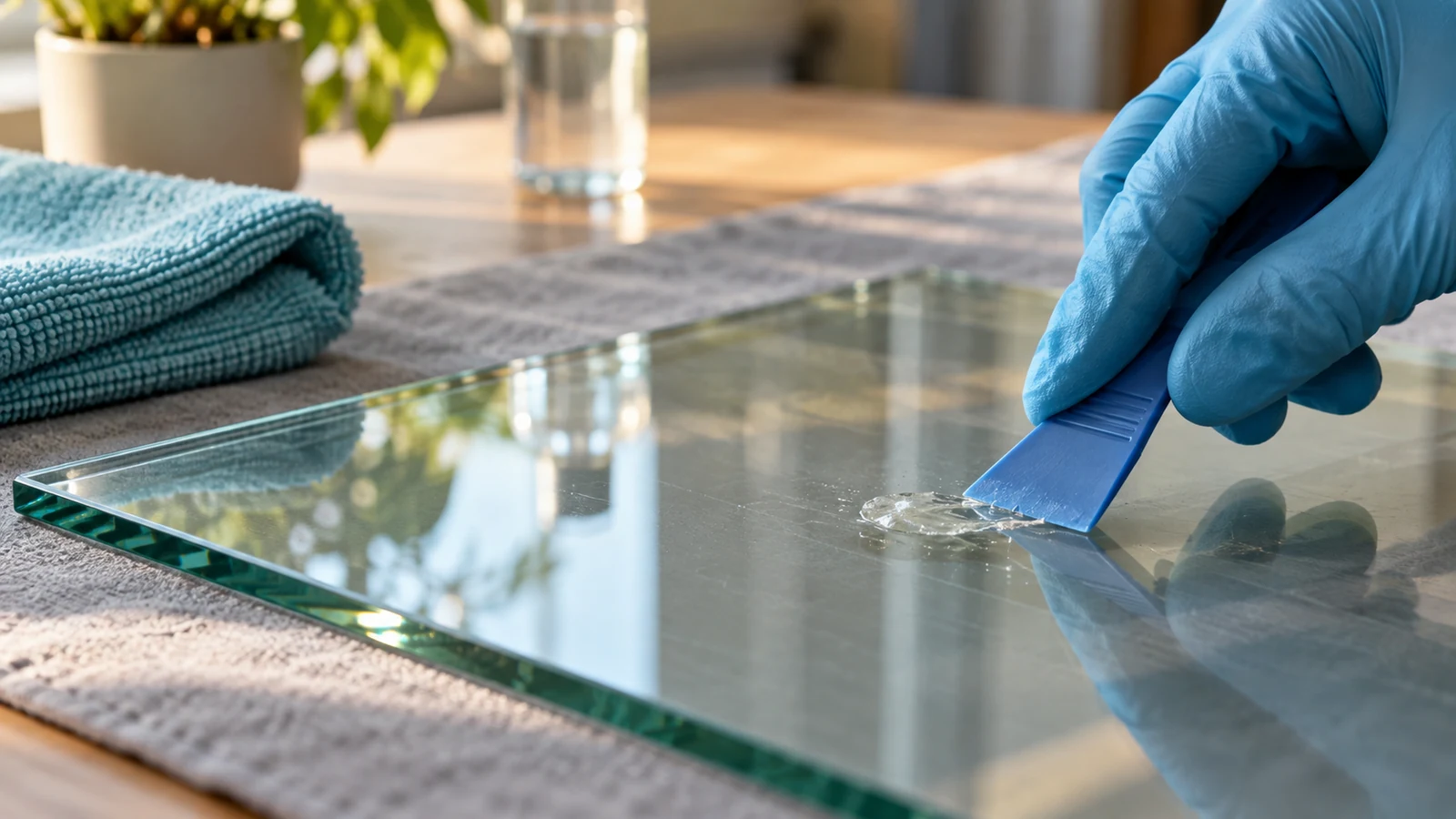
To remove super glue from ordinary, uncoated glass, soften the cyanoacrylate with acetone for 1-5 minutes, then slide a fresh razor scraper under the softened residue at a low angle. Wash the area with dish soap and water afterward. Avoid acetone and metal blades on plastic lenses, phone screens, painted frames, and unknown coatings.
Key Facts at a Glance
- Acetone is usually the fastest remover for cured super glue on bare window, jar, mirror, and tabletop glass.
- A razor scraper should travel nearly parallel to the glass, with its edge around 15-30 degrees from the surface.
- Acetone can damage acrylic, polycarbonate, paint, rubber seals, laminates, and anti-reflective or oleophobic coatings.
- Isopropyl alcohol can help with fresh, thin residue but is normally slower than acetone on hardened glue.
- Warm soapy water is the safest first treatment when the glass type or surface coating is uncertain.
- Never use boiling water or a heat gun to shock cold glass, because uneven heating can crack or shatter it.
What Is Super Glue, and Why Does It Stick to Glass?
Super glue is a cyanoacrylate adhesive that hardens when trace moisture initiates rapid polymerization. The liquid monomers join into a rigid plastic-like polymer, while the smooth glass provides a clean, stable surface for close chemical contact.
The adhesive does not usually soak into glass. That matters because a surface bond can be softened and lifted without removing material from the glass itself. Acetone acts mainly as a solvent and swelling agent for the cured residue; it does not reliably reverse polymerization into the original liquid monomer.
Glass is chemically resistant to brief acetone contact, but the complete assembly may not be. A window with a vinyl frame, a mirror with a painted backing, or a display with adhesive seals can suffer damage even when the glass face remains intact.
Which method fits the glass object?
Bare flat glass generally permits the strongest method, acetone followed by a scraper. Coated lenses and electronic displays require the least aggressive method because the vulnerable component is often the coating, edge seal, plastic substrate, or surrounding frame rather than the glass.
| Glass object | First choice | Avoid first | Typical time |
|---|---|---|---|
| Window glass | Acetone plus razor scraper | Heat gun near seals | 5-15 minutes |
| Glass jar or tabletop | Acetone plus plastic or razor scraper | Abrasive powder | 5-10 minutes |
| Mirror front surface | Acetone on a swab, controlled wiping | Soaking edges and backing | 5-15 minutes |
| Eyeglass mineral lenses | Warm soapy water, optical cloth | Unverified acetone use | 15-30 minutes |
| Polycarbonate lenses | Soapy water and plastic pick | Acetone and metal blades | 20-40 minutes |
| Phone or tablet display | Professional repair or plastic tool | Acetone, heat, and metal blades | Variable |
What You Need Before Removing the Glue
For a small deposit on bare glass, prepare 100% acetone, disposable cotton swabs or a small folded cloth, dish soap, water, microfiber cloths, nitrile gloves, and a new razor scraper. Use only enough acetone to wet the residue, not enough to flood the surrounding frame or run into an edge.
The typical household cost is about $5-$15 in the United States if you already own a scraper. A purpose-made glass scraper commonly costs $5-$12, while acetone or acetone-based nail-polish remover usually costs $3-$8. Use pure acetone when possible because additives in polish remover may leave a film.
Before-you-start checklist
| Requirement | Typical specification | Why it matters |
|---|---|---|
| Acetone | 100%, 1-2 teaspoons for a small spot | Softens cured cyanoacrylate |
| Razor scraper | New single-edge blade, 1-1.5 inches wide | Reduces snagging and scratches |
| Dish soap | 1-2 drops in 250-500 milliliters of water | Removes solvent and oily film |
| Gloves | Nitrile, chemical-resistant | Limits skin and solvent contact |
| Ventilation | Open window or active exhaust | Reduces vapor accumulation |
| Cloth | Lint-free microfiber | Prevents abrasive grit and fibers |
Work away from flames, pilot lights, cigarettes, and hot electrical equipment. Acetone is highly flammable and evaporates quickly. Test the solvent on an inconspicuous surrounding material first, especially when the glass has paint, tint, laminate, rubber, plastic, or a decorative finish.
How to Remove Super Glue From Bare Glass
The most reliable process takes 5-15 minutes for a small spot: remove loose material, soften the glue, lift it with a low-angle scraper, and wash away the remaining film. The factor that most affects success is controlled solvent contact, because a dampened residue releases cleanly while a barely moistened deposit remains brittle.
Step 1: Identify the surface
Confirm that the affected area is bare, hard glass rather than a coated lens, display, acrylic panel, or painted surface. If you cannot identify the substrate, begin with warm soapy water and a plastic card instead of acetone and steel.
Remove dust with a dry microfiber cloth. Grit trapped beneath a scraper can create scratches even when the blade itself is sharp.
You will know this step worked when: the area is clean enough to see the glue edge and no loose grit remains.
Common mistake: treating every transparent surface as glass.
Step 2: Remove loose glue without spreading it
For fresh super glue, do not wipe repeatedly with a dry cloth. Blot the excess from the outside toward the center with a disposable tissue or cotton swab, then allow the remaining spot to harden if it smears.
For hardened glue, trim only large, unstable flakes with a plastic card. Do not force a scraper through a thick blob before solvent softening.
You will know this step worked when: the remaining deposit has a defined edge and no wet adhesive is spreading across the glass.
Common mistake: rubbing fresh cyanoacrylate, which enlarges the contaminated area.
Step 3: Soften the cyanoacrylate with acetone
Wet a cotton pad, swab, or folded cloth with acetone and place it directly over the glue. Keep the contact area small, and leave it for 1-2 minutes for a thin film or 3-5 minutes for a thick, cured blob.
For vertical glass, tape plastic film over the damp pad to slow evaporation, but do not seal a large quantity of solvent in a poorly ventilated room. Reapply acetone if the pad dries before the glue changes texture.
You will know this step worked when: the glue becomes dull, softened, gummy, or easier to mark with a plastic edge.
Common mistake: using an acetone-based remover that contains oils, dyes, or conditioners, then mistaking the leftover film for glue.
Step 4: Lift the softened glue
Hold a new razor scraper at approximately 15-30 degrees to the glass. Push the blade forward in short, overlapping strokes, keeping the edge nearly flat and moving away from your fingers.
Use a plastic razor or old gift card when the surface has a coating or when the glass identity is uncertain. Replace a blade that catches, skips, or has a visible nick; damaged metal edges concentrate force and can scratch.
You will know this step worked when: the deposit comes away in curls, flakes, or a soft ribbon rather than powdering under pressure.
Common mistake: pulling the blade upward or using the corners as a chisel.
Step 5: Clean the remaining film
Apply a small amount of acetone to a fresh swab and wipe only the affected area. Follow immediately with warm water containing one or two drops of dish soap, then rinse and dry with microfiber.
Do not polish aggressively while solvent remains on the surface. The microfiber cloth should remove the final film, not provide the force needed to grind away hardened glue.
You will know this step worked when: the glass looks clear at a side angle under bright light and feels smooth when rinsed and dried.
Common mistake: leaving acetone around a frame, gasket, or mirror edge.
Step 6: Inspect under angled light
Shine a lamp across the surface rather than directly at it. Angled light reveals a transparent polymer smear that may be invisible from straight on.
If a haze remains, repeat the short acetone treatment once, then wash again. Two controlled applications are safer than one prolonged soak around an unknown edge.
You will know this step worked when: no raised edge, sticky patch, or rainbow-like film remains.
Common mistake: switching immediately to abrasive powder or steel wool.
Which Super Glue Removal Method Should You Choose?
Acetone is the best overall method for thick or cured super glue on uncoated, flat glass. Mechanical scraping is fastest for a thin, isolated ridge, while warm soapy water is the safest starting point for coated or unidentified surfaces.
| Method | Best surface | Contact time | Main risk | Typical cost |
|---|---|---|---|---|
| Acetone | Bare glass, cured blobs | 1-5 minutes | Frame or coating damage | $3-$8 |
| Razor scraper | Flat bare glass, softened residue | 1-5 minutes | Scratches or cuts | $5-$12 |
| Isopropyl alcohol | Fresh, thin residue | 5-15 minutes | Insufficient softening | $3-$7 |
| Warm soapy water | Lenses, uncertain surfaces | 15-40 minutes | Slow progress | Under $2 |
| Cooking oil or WD-40 | Sticky film and vertical spots | 5-15 minutes | Greasy residue | $5-$10 |
| Plastic card or pick | Coated surfaces and displays | 5-30 minutes | Smearing or bending | $1-$8 |
Is acetone better than rubbing alcohol?
Acetone is generally faster on cured cyanoacrylate, while 90% or higher isopropyl alcohol is a gentler option for fresh, thin residue and nearby plastic. Alcohol may soften the surface without fully releasing a thick, aged deposit, so repeated wiping can spread the softened adhesive.
Use alcohol when the glass assembly includes sensitive plastic and the glue is only a small smear. Use acetone only after confirming that nearby materials tolerate it.
Can oil or WD-40 remove super glue?
Oil-based products can loosen residue and reduce scraper friction, but they are not as dependable as acetone for dissolving a thick cyanoacrylate deposit. WD-40 can help on vertical glass because its thicker liquid is less likely to run immediately.
Apply a small amount for about five minutes, lift the softened residue with plastic, then wash twice with dish soap. Oil left on glass creates streaks and can transfer onto seals or painted surfaces.
How Long Does Super Glue Removal Take?
A fresh smear on bare glass may take 2-5 minutes, while a thick cured blob usually takes 5-15 minutes and one or two solvent applications. Coated lenses and screens can require 15-40 minutes because only low-risk mechanical and soapy-water methods are appropriate.
| Residue condition | Recommended treatment | Typical contact time | Likely repetitions |
|---|---|---|---|
| Fresh liquid smear | Blot, then alcohol or acetone | 30-90 seconds | 1 |
| Thin dried film | Acetone and low-angle scrape | 1-3 minutes | 1 |
| Thick cured drop | Acetone-soaked pad and scrape | 3-5 minutes | 1-3 |
| Glue in a narrow joint | Swab and plastic pick | 5-10 minutes | 2-4 |
| Coated lens residue | Soapy water and optical cloth | 15-30 minutes | 2-3 |
| Display-edge residue | Professional assessment | Variable | Do not force |
These are typical practical ranges, not guarantees. Glue thickness, age, temperature, solvent purity, and the presence of a coating change the result.
What Changes for Mirrors, Eyeglasses, and Phone Screens?
Bare mirror glass can usually tolerate a carefully controlled acetone application on its front face, but acetone should not reach the mirror edge or rear backing. A mirror is a layered product: damage to the silvering, paint, adhesive, or edge seal may appear later even when the front looks clean.
Eyeglasses require identification before treatment. Mineral glass lenses may tolerate acetone better than plastic lenses, but anti-reflective, UV, hydrophobic, and oleophobic coatings can be damaged by solvents or scraping. Warm water, neutral dish soap, and a clean optical microfiber cloth are the safe first steps; an optician should handle stubborn residue.
Phone and tablet displays should not receive acetone, nail-polish remover, heat guns, or metal razor blades. Modern screens commonly combine cover glass with coatings, display adhesives, seals, and plastic components. Use a barely damp microfiber cloth and a plastic pick only on a loose surface deposit, and seek repair help if glue reaches an edge, speaker opening, button, or seam.
What Are the Most Common Removal Mistakes?
The most expensive mistakes involve treating the glass face while ignoring the materials attached to it. A successful solvent treatment can still ruin a vinyl frame, lens coating, painted mirror backing, or display seal.
- Flooding the area with acetone: Apply it to a swab or small pad instead of pouring it onto the surface. Flooding increases migration into frames and seams.
- Using a blade on coated glass: A metal edge can remove anti-reflective or oleophobic layers even when it does not visibly scratch the underlying glass.
- Scraping a dry blob: Dry force can chip the edge of glass or create a scratch. Soften first, then push nearly parallel to the surface.
- Using boiling water or a heat gun: Uneven heating creates thermal stress, especially in tempered, laminated, or cold glass. Gentle room-temperature methods are safer.
- Using baking soda as the primary remover: Baking soda is mildly abrasive, not a cyanoacrylate solvent. It may dull coatings and spread a film.
- Mixing cleaning chemicals: Never combine acetone with bleach, oxidizers, or unknown cleaners. Use one product, remove it, then wash the surface.
Expert rule: scrape in the safest direction
Push a scraper toward an open area, not toward a glass edge, corner, gasket, or your hand. A blade that meets an edge can climb, chip, or suddenly release. Short forward strokes provide more control than long sideways pulls.
Expert rule: the glue edge matters more than the center
Solvent must reach the boundary between adhesive and glass. Pressing a damp swab against the center of a thick blob may soften only its surface, while working around the perimeter lets the scraper enter beneath the deposit.
Expert rule: use light to verify, not force
A haze seen under angled light often needs another brief solvent application, not stronger abrasion. Glass can tolerate more force than a coating can, so visual inspection should determine whether to repeat the process.
How Do You Fix Problems After Removal?
A white, powdery residue usually means the outer layer dried before the solvent reached the bond line. Re-wet a small pad, hold it over the area for another 2-5 minutes, and lift the softened layer rather than rubbing the powder across the glass.
A transparent haze is often a thin re-hardened polymer film or oily cleaner residue. Try one controlled acetone wipe on confirmed bare glass, then wash with warm dish-soap solution. Do not use steel wool, abrasive polishing compound, or forceful scrubbing on coated surfaces.
| Problem | Probable cause | Recovery action | Stop condition |
|---|---|---|---|
| Glue turns white | Surface dried too quickly | Reapply acetone for 2-5 minutes | Frame begins softening |
| Blade skips | Glue remains hard or blade is damaged | Re-wet and replace blade | Any visible scratch |
| Sticky ring remains | Polymer at the bond edge | Treat the perimeter with a swab | Coating looks cloudy |
| Greasy streaks remain | Oil or WD-40 residue | Wash twice with dish soap | Surface remains hazy |
| Lens looks rainbowed | Coating damage | Stop and contact an optician | Color persists after washing |
| Display edge feels loose | Solvent or heat affected adhesive | Stop and seek repair | Any screen separation |
Stop immediately if the glass cracks, the surrounding material softens, a coating changes color, or the blade starts catching. Further cleaning cannot safely reverse structural or coating damage.
FAQ
Will vinegar remove super glue from glass?
Vinegar is not a strong remover for cured cyanoacrylate. It may help clean mineral deposits or mild surface residue after the adhesive has been removed, but acetone is more effective on confirmed bare glass. Never substitute vinegar for solvent softening when a thick glue blob remains.
Can I remove super glue from a glass table without scratching it?
Yes. Use acetone on bare glass, soften the deposit for 1-5 minutes, and push a new razor scraper at 15-30 degrees. Keep the blade flat, use short strokes, and inspect under angled light. If the tabletop has a coating, tint, paint, or laminate, use a plastic scraper and test first.
How do I remove super glue from glass with no acetone?
Start with warm water and dish soap for 15-30 minutes, then lift the softened edge with a plastic card. High-strength isopropyl alcohol may help thin residue, but thick cured glue may require several treatments. Do not compensate with more force, boiling water, or abrasive powder.
Can a hair dryer loosen super glue on glass?
A hair dryer on its lowest setting may warm a small area gradually, but heat is less predictable than solvent and may damage frames, seals, or coatings. Keep the dryer moving, avoid concentrated heat, and never heat cold tempered or laminated glass rapidly. Do not use a heat gun.
Does super glue permanently damage glass?
Super glue normally does not chemically etch ordinary glass, so careful removal usually restores the surface. Permanent damage can still result from an abrasive contaminant, a high-angle blade, thermal shock, or solvent attack on a coating, mirror backing, plastic lens, or display adhesive.
Should I call a professional?
Call an optician for coated eyeglasses, a device repair technician for phones and tablets, and a glazier for cracked, large, tempered, or difficult-to-access glass. Professional help is warranted when glue touches a seal, edge, painted backing, electrical opening, or a surface whose coating cannot be identified.
The Bottom Line
For ordinary uncoated glass, the safest fast method for how to remove super glue from glass is controlled acetone softening followed by a low-angle razor scrape and a dish-soap rinse. Use warm soapy water and plastic tools when coatings or plastic parts are present, and avoid acetone, metal blades, boiling water, and heat guns on lenses and electronic displays.