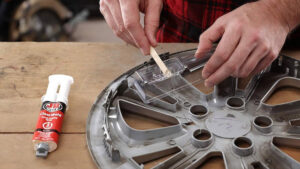
Super glue is a cyanoacrylate adhesive that cures when moisture triggers its monomers to polymerize into a hard plastic film. To remove it from metal, soften the bond with acetone or a cyanoacrylate debonder, then lift the softened material with a non-scratching tool; raw metal is usually more forgiving than painted, plated, or polished metal.
Key Facts
Pure acetone usually loosens a thin cyanoacrylate spot in 5-15 minutes.
Thick deposits may need several applications rather than one long soak.
Acetone is generally suitable for bare steel and many other raw metals, but it can damage paint, lacquer, plastic, rubber, and some clear coats.
Plastic scrapers and wooden picks reduce scratching on aluminum, brass, chrome, and jewelry.
Heat can soften some deposits, but burning cyanoacrylate creates irritating fumes.
Dry raw iron or steel immediately after water-based cleaning to reduce flash rust.
What Is Super Glue, and Why Does It Stick to Metal?
Super glue is a cyanoacrylate adhesive that forms a rigid polymer when exposed to trace moisture on surfaces and in the air. Metal does not absorb the adhesive, so the bond remains at the surface, where the cured polymer grips microscopic scratches, machining marks, and contamination.
The adhesive is strongest when the metal surfaces fit closely and remain clean. A thick blob, however, is often easier to remove than a thin film because a solvent can reach its exposed edges. A thin smear may require patience because the solvent has little exposed surface area.
Metal is non-porous, but “metal” is not a complete description of the workpiece. Aluminum, brass, copper, chrome plating, anodizing, powder coating, automotive paint, and clear lacquer respond differently to solvents and abrasion.
Cured glue, wet glue, and white residue
Fresh, liquid cyanoacrylate should be blotted carefully rather than rubbed across a large area. Rubbing spreads the adhesive and increases the contaminated surface.
Cured glue is hard, clear, white, or amber and usually responds to solvent, controlled mechanical removal, or both. White haze around a joint is often cyanoacrylate blooming, a vapor deposit caused by excess adhesive, restricted airflow, or nearby moisture. Blooming is thinner than a glue pool and usually needs surface-safe polishing after solvent testing.
How Do You Choose a Removal Method?
The safest method depends first on the finish, then on the glue thickness and the shape of the part. Use solvent on bare metal, careful mechanical lifting on delicate finishes, and controlled warmth only when the object can tolerate temperature and fumes.
Inspect the object before applying anything. Identify whether the surface is:
- Bare steel, stainless steel, aluminum, brass, or copper
- Chrome-plated, nickel-plated, anodized, or chemically blackened
- Painted, powder-coated, lacquered, or clear-coated
- Polished, brushed, mirror-finished, or intentionally patinated
- Attached to plastic, rubber, electronics, fabric, or a heat-sensitive component
Test the selected product on an unseen area for 5 minutes, then wipe and inspect under strong light. A finish that looks unchanged while wet can become dull after drying.
| Surface or object | First choice | Typical working time | Main hazard |
|---|---|---|---|
| Bare stainless steel | Acetone and plastic scraper | 5-20 minutes | Smearing residue |
| Bare aluminum | Acetone and wooden pick | 5-15 minutes | Scratches and staining |
| Brass or copper | Solvent spot test, then plastic tool | 5-20 minutes | Loss of polish or patina |
| Chrome plating | Cotton swab and gentle lifting | 5-15 minutes | Scratched or lifted plating |
| Painted steel | Plastic lifting and mild cleaner | 10-30 minutes | Paint softening |
| Jewelry with stones | Jeweler-approved method | 5-20 minutes | Stone, plating, or setting damage |
| Threaded steel hardware | Acetone applied locally | 10-30 minutes | Solvent reaching seals |
Expert insight: The metal itself is often not the vulnerable part. The coating, adhesive under a trim piece, rubber seal, or plastic insert usually fails first. Treat the entire assembly, not only the visible metal.
How to Remove Super Glue From Bare Metal
Acetone is the most practical first-line solvent for a small deposit on uncoated metal. It does not magically reverse polymerization, but it can swell and weaken cured cyanoacrylate enough for the film to shear away.
What you need
| Item | Typical amount or specification | Purpose | Typical cost |
|---|---|---|---|
| Pure acetone | 30-100 mL | Softens cyanoacrylate | $5-$10 |
| Nitrile gloves | 1 pair, 6-8 mil preferred | Limits skin contact | $0.20-$1 |
| Plastic scraper | 1 tool, rounded edge | Lifts softened glue | $2-$6 |
| Cotton swabs or lint-free cloth | 5-10 pieces | Local application | $1-$5 |
| Mild dish detergent | 5-10 mL per liter of water | Final cleaning | $1-$4 |
| Light machine oil | 1-3 drops | Protects bare steel | $4-$10 |
Work with ventilation and remove ignition sources. Acetone is highly flammable, and its vapor can travel to a flame or spark. Wear eye protection when scraping because brittle glue can chip unexpectedly.
The removal process
- Remove loose material first. Lift a thick edge with a plastic scraper, wooden pick, or fingernail protected by a glove. Do not gouge underneath the adhesive.
- Apply acetone locally. Wet a cotton swab or small cloth and press it against the deposit. Limit the wet area on parts with seals, labels, paint, or adjacent plastic.
- Wait 5-15 minutes. Reapply when the solvent evaporates. A thick blob may need 20-30 minutes across several applications.
- Test the edge. A softened deposit may feel rubbery, chalky, or less firmly attached. Push sideways rather than digging downward.
- Repeat in thin layers. Remove the softened outer layer, then expose the next layer to fresh solvent.
- Clean the residue. Wipe with a fresh solvent-dampened cloth, followed by mild soapy water.
- Dry and protect. Dry steel immediately. Apply a very thin film of machine oil to raw iron or carbon steel if the part will be stored.
Do not seal acetone beneath plastic wrap on an unknown finish. Occlusion increases solvent contact and can soften coatings, printed markings, adhesives, and elastomers.
Why thick glue may resist the first application
A cured cyanoacrylate mass has a low surface area relative to its volume. Acetone attacks the exposed surface first, so the outside may soften while the center remains hard. Scoring the deposit lightly with a plastic tool and removing layers exposes fresh adhesive without forcing a blade against the metal.
For a glue-filled hole or recess, use a wooden toothpick to remove softened material. Avoid steel picks on aluminum and polished surfaces because one slip can create a permanent line.
Is Acetone Safe for Painted or Plated Metal?
Acetone can remove or dull paint, lacquer, some clear coats, powder-coat binders, screen printing, and protective finishes even when the underlying metal is unaffected. On coated metal, mechanical lifting and a finish-compatible cleaner are safer starting points than a broad solvent soak.
Safer methods for coated surfaces
Use a plastic razor blade, nylon scraper, bamboo pick, or wooden cuticle stick. Hold the tool nearly parallel to the surface and push toward an exposed edge. This reduces the chance of cutting through a coating.
For automotive panels, appliance housings, painted tools, and powder-coated brackets, test a small amount of isopropyl alcohol on an inconspicuous area. Alcohol is weaker against cured cyanoacrylate than acetone, but it may remove light residue while preserving some finishes. It is not a dependable solution for a thick deposit.
Commercial cyanoacrylate debonders may contain nitromethane, acetone, or other solvents. Read the label and check compatibility with the finish. “Safe for metal” does not mean safe for paint, plating, plastic, rubber, or decorative lacquer.
| Finish | Acetone risk | Safer first tool | Escalation option |
|---|---|---|---|
| Bare stainless steel | Low | Plastic scraper | Local acetone |
| Anodized aluminum | Medium to high | Nylon scraper | Manufacturer-approved cleaner |
| Automotive clear coat | High | Plastic razor | Detailer or body-shop advice |
| Powder coating | Medium to high | Nylon scraper | Coating-compatible debonder |
| Chrome plating | Medium | Wooden pick | Cotton-swab debonder test |
| Lacquered brass | High | Soft wooden tool | Professional refinishing advice |
Expert insight: Always test the finish after the solvent has evaporated. Solvent damage often appears as haze, tackiness, color transfer, or loss of gloss rather than immediate peeling.
Can Heat or Boiling Water Remove Cyanoacrylate?
Moderate heat can soften some cyanoacrylate deposits, but it is less predictable than solvent and should never be used to burn the glue. Boiling water may help on a small, heat-safe, uncoated metal object, while a heat gun is better reserved for thick, bare-metal hardware that cannot be damaged by warmth.
Cyanoacrylate behavior varies with formulation, thickness, age, and the surrounding assembly. A temperature that loosens adhesive may also discolor plating, damage temper, warp thin sheet, melt nearby plastic, or release irritating fumes.
Controlled heat procedure
Use a heat gun on its lowest practical setting, keep it moving, and warm the metal in short 10-15 second intervals. Try lifting the adhesive after each interval. Stop if the glue smokes, the metal changes color, or an odor becomes sharp and irritating.
Do not use a torch on a small precision part, a plated object, a painted panel, or anything containing oil, batteries, seals, or electronics. Direct flame can overheat the metal locally even when the surrounding surface feels cool.
For boiling water, place only a heat-safe bare-metal item in the water for 5-10 minutes, remove it with tongs, and try a plastic tool while the deposit is warm. Dry carbon steel immediately and oil it lightly. Water alone rarely dissolves a thick cured mass.
| Heat option | Typical temperature | Working period | Appropriate use |
|---|---|---|---|
| Warm tap water | 40-60°C | 10-20 minutes | Small bare hardware |
| Boiling water | About 100°C | 5-10 minutes | Heat-safe uncoated parts |
| Low heat gun | About 60-120°C at the work area | 10-60 seconds per cycle | Thick bare steel |
| Open flame | Local temperatures exceed 300°C | Avoid | Not recommended for glue removal |
Which Method Is Best for Different Metal Objects?
The best technique changes with geometry, finish, and the consequences of damage. A tool with a thick glue pool tolerates more mechanical force than a plated watch case or a precision bearing seat.
| Object or situation | Recommended sequence | Avoid | Typical total time |
|---|---|---|---|
| Bare steel tool | Acetone, plastic scraper, oil | Torch near grease | 10-30 minutes |
| Aluminum component | Local acetone, wooden pick | Steel wool and hard blades | 10-25 minutes |
| Ring or metal jewelry | Swab test, debonder, soft cloth | Soaking unknown stones | 10-30 minutes |
| Painted car panel | Plastic razor, finish-safe cleaner | Acetone and heat gun | 15-45 minutes |
| Glue in screw threads | Local solvent, nylon brush, chase gently | Forcing the fastener | 20-45 minutes |
| Metal hinge | Solvent at the joint, repeated movement | Flooding bearings or seals | 15-40 minutes |
| Precision instrument | Manufacturer guidance first | Uncontrolled solvent or heat | Variable |
| Antique or patinated object | Conservator assessment | Abrasion and polishing | Variable |
Jewelry requires special care because acetone can affect plating, soft stones, pearls, opals, glued settings, and hidden finishes. Remove stones only when a jeweler confirms compatibility. Do not place a valuable antique in boiling water or scrub away a historic patina.
For a seized threaded fastener, apply solvent with a needle-tip bottle or cotton swab, wait 10 minutes, and work the fastener back and forth in small movements. A nylon brush can clean exposed threads. If the adhesive reaches a bearing, seal, or electrical connector, disassembly may be safer than flooding the joint.
What If Acetone Does Not Work?
Acetone may fail when the deposit is too thick, the solvent cannot reach the bond line, the product is not cyanoacrylate, or a coating prevents contact. Failure after one application does not prove that the adhesive is solvent-proof.
Use this troubleshooting sequence:
- Confirm the material. Epoxy, threadlocker, silicone, and construction adhesive require different removal methods.
- Expose an edge. Remove only the outer softened layer with a plastic scraper.
- Use fresh solvent. Dirty or diluted solvent loses effectiveness.
- Increase contact, not aggression. Apply repeated local treatments rather than pressing harder with a blade.
- Try a labeled debonder. Choose a product whose instructions list cured cyanoacrylate and the specific finish.
- Stop when the substrate changes. Haze, paint transfer, softening, or discoloration means the finish is at risk.
Isopropyl alcohol is useful for fingerprints and light residue, but it is usually too weak to remove a thick cured deposit. Mineral spirits are also poor first choices for cyanoacrylate and can leave an oily film that complicates later cleaning.
How Do You Prevent Scratches, Fumes, and Rust?
Surface damage usually comes from the removal tool, not from the original adhesive. Keep the tool edge shallow, use fresh solvent, and work from the glue perimeter toward the center.
Follow these rules:
- Use plastic, nylon, bamboo, or wood on polished and soft metals.
- Reserve brass brushes for sturdy bare metal, and test first on aluminum or brass.
- Avoid steel wool on chrome, aluminum, polished brass, and decorative finishes.
- Never mix acetone with bleach, oxidizers, or unknown cleaners.
- Keep solvent-soaked cloths away from heaters, pilot lights, and sparks.
- Do not heat cyanoacrylate until it smokes.
- Wash hands after removing gloves, even when skin contact seems absent.
- Dry iron and carbon steel immediately after water cleaning.
- Inspect grooves and seams because hidden residue can re-bond after the surface dries.
Expert insight: A razor blade can be safe on a flat, uncoated steel plate when held nearly flat, yet dangerous on the same steel after it reaches a corner or burr. Tool angle matters as much as tool hardness.
How Much Do Supplies Cost and How Long Does Removal Take?
A small household repair typically costs $5-$20 when acetone, gloves, and a plastic scraper are already available. A professional debonder, specialty tools, or jewelry and automotive service can raise the cost to approximately $10-$100 or more.
| Project type | Supplies cost | Solvent or working time | Typical total time |
|---|---|---|---|
| Small bare-metal spot | $5-$12 | 5-15 minutes | 10-20 minutes |
| Thick glue pool on a tool | $8-$20 | 15-30 minutes | 20-45 minutes |
| Painted automotive part | $5-$25 | 10-30 minutes | 15-45 minutes |
| Jewelry or plated object | $10-$30 DIY | 5-20 minutes | 15-40 minutes |
| Professional jewelry service | $30-$100+ | Varies | Same day to several days |
These are typical consumer ranges, not fixed prices. Location, brand, finish testing, disassembly, and the value of the object affect the final cost.
Frequently Asked Questions About how to remove super glue from metal
Will WD-40 dissolve super glue on metal?
WD-40 may lubricate a scraper and help remove oily residue, but it is not a reliable solvent for cured cyanoacrylate. Use acetone or a labeled debonder for the adhesive, then clean away the lubricant and apply only a thin protective film to raw steel.
Can vinegar remove cyanoacrylate from steel?
Vinegar is not a dependable remover for cured super glue. Its acidity may affect some metals or finishes after prolonged contact, while the polymer usually remains attached. Use a tested solvent and mechanical lifting instead, then dry the steel to prevent corrosion.
Is nail polish remover strong enough?
Some nail polish removers contain acetone and can loosen super glue, but others are acetone-free or include oils, water, and fragrances. Check the ingredient label. Pure acetone is more predictable on bare metal, while either product requires a finish compatibility test.
How do you remove super glue from a metal surface without acetone?
Use a plastic scraper, wooden pick, or nylon brush to lift as much as possible, then try a commercial cyanoacrylate debonder or carefully controlled warmth on heat-safe bare metal. Repeated gentle passes are safer than aggressive scraping, especially on aluminum, plating, and painted surfaces.
Can super glue be removed from metal threads?
Yes, if the fastener and surrounding components tolerate the solvent. Apply acetone or debonder locally, wait 10-30 minutes, and move the fastener in small increments. Avoid flooding seals, bearings, wiring, or plastic inserts, and use a nylon brush to clean exposed thread valleys.
What should you do after removing the adhesive?
Wipe away solvent residue, wash the surface with mild soapy water when compatible, and dry it completely. Inspect under angled light for a remaining film. Protect bare iron or carbon steel with a very thin coat of machine oil, but keep oil away from bonding surfaces.
Conclusion
The safest way to remove super glue from metal is to identify the finish, soften the cyanoacrylate locally with acetone or a suitable debonder, and lift it gradually with a plastic or wooden tool. Bare steel usually tolerates this process well, while painted, plated, polished, and anodized surfaces need spot testing, limited solvent contact, and minimal abrasion.