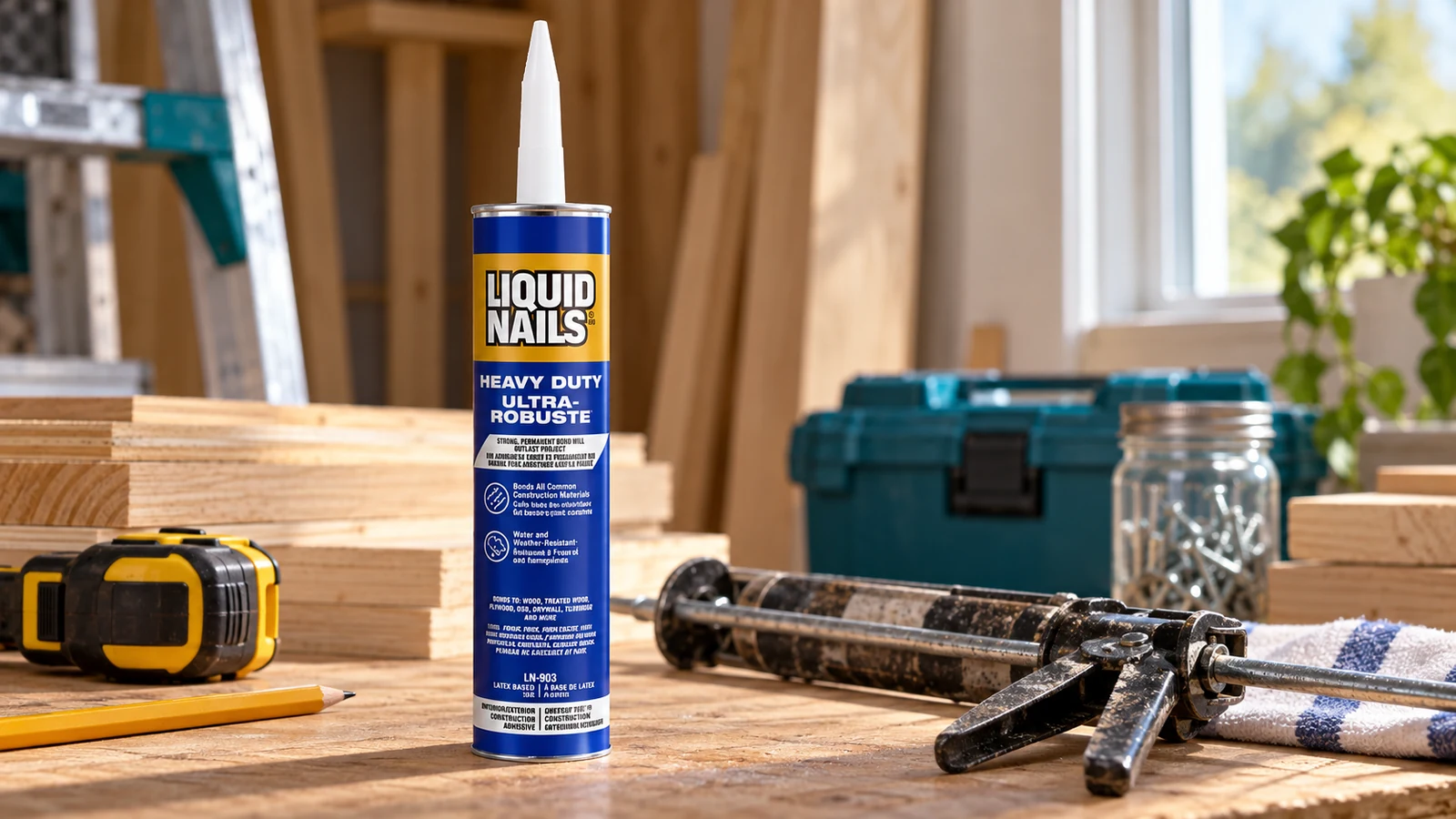
Liquid Nails is a branded construction adhesive that does expire because its carrier, polymers, and curing system degrade or react during storage. An unopened cartridge commonly remains usable for about 12-24 months, while an opened cartridge may last weeks to several months. The product label and technical data sheet for the exact formula take priority over any general shelf-life estimate.
Key facts
An unopened cartridge is typically usable for 12-24 months when stored cool, dry, and within the manufacturer’s stated conditions.
An opened tube deteriorates faster because air, moisture, and a blocked or damaged nozzle allow curing inside the cartridge.
A hard plug at the tip does not automatically mean the entire tube has failed, but gritty, separated, watery, or rubbery adhesive is a rejection sign.
Test old adhesive on scrap material before using it on trim, cabinetry, panels, flooring, or anything difficult to replace.
Do not rely on aged adhesive alone for a safety-critical, overhead, load-bearing, or code-regulated connection.
Exact cure time depends on formula, temperature, humidity, bead thickness, ventilation, and substrate porosity.
How Long Does Liquid Nails Last?
Liquid Nails generally lasts 12-24 months unopened and substantially less time after opening. The range is typical rather than a universal expiration rule because Liquid Nails includes water-based, solvent-based, polyurethane, hybrid, specialty, and regional formulas with different packaging and curing systems.
A printed expiration date, use-by date, or manufacturer batch guidance outranks a generic estimate. If no clear date appears, photograph the cartridge and ask the manufacturer or retailer to interpret the batch code. Batch-code formats can change, so treating the first digits as a guaranteed manufacturing date is unreliable.
| Storage condition | Unopened cartridge | Opened cartridge | Practical decision |
|---|---|---|---|
| 10-22°C, dry indoor cabinet | Typically 12-24 months | Typically 1-6 months | Inspect and test |
| Hot shed above 32°C | Shortened, variable | Often weeks to 2 months | Replace if aged |
| Repeated freezing | Possible separation or damage | High failure risk | Do not assume recovery |
| Wet, dirty, damaged nozzle | Not applicable | Days to weeks | Replace or test immediately |
| Original seal intact, date known | Use manufacturer date | Not applicable | Follow label |
The important distinction is between shelf life and usable life. Shelf life is the period the manufacturer supports under specified conditions. Usable life is what an individual cartridge can still achieve after heat, freezing, contamination, age, and poor sealing have changed its condition.
What Makes Old Construction Adhesive Fail?
Old construction adhesive fails when water or solvent escapes, the polymer reacts prematurely, or the ingredients separate and cannot be remixed into a uniform compound. Heat accelerates aging, freezing can damage water-based emulsions, and a poorly sealed nozzle exposes the remaining material to air and moisture.
A cartridge can look acceptable externally while its adhesive has lost bond performance. Conversely, a small cured plug at the nozzle can protect adhesive behind it. The visible tip is therefore a screening clue, not proof of the whole cartridge’s condition.
How Do You Tell Whether a Cartridge Has Expired?
You can assess an old cartridge through its date, packaging, extrusion, texture, odor, and a controlled test bond. No single visual sign proves performance, so reject material that shows multiple warning signs or that will be used where failure has serious consequences.
Inspection Checklist
Look for these conditions before loading the cartridge into a caulking gun:
- Unknown age combined with cracked, bulging, leaking, or badly corroded packaging.
- A separated liquid layer that does not become uniform after gentle kneading where the label permits it.
- Watery, lumpy, grainy, stringy, or crumbly material.
- A strong, abnormal odor compared with a fresh cartridge of the same formula.
- Adhesive that will not extrude continuously, even after replacing the nozzle.
- A nozzle plug extending far into the cartridge.
- A skin or cured mass across the entire exposed opening.
- Frozen, overheated, or repeatedly temperature-cycled storage history.
Do not puncture a pressurized or damaged cartridge. Wear eye protection and gloves, and follow the product Safety Data Sheet, especially with solvent-based formulas.
The 24-Hour Test-Bond Method
A small test bond is more useful than judging the adhesive by color alone. Use the same materials, surface preparation, bead size, and approximate conditions expected in the real project.
- Cut two scrap pieces of the actual substrates, such as painted wood, drywall, masonry, metal, or plastic.
- Clean dust, oil, release agents, and loose paint from the bonding faces.
- Extrude a continuous bead and note whether the paste is smooth and consistent.
- Join the pieces using the same pressure and gap that the final installation requires.
- Brace the samples and leave them undisturbed for at least 24 hours, or longer if the label specifies it.
- Try to separate the pieces by hand without twisting dangerously or using a tool that creates excessive leverage.
- Reject the cartridge if the bond remains wet, peels cleanly, stays unusually soft, or fails far below a fresh-product sample.
This test does not certify structural strength. It only reduces the risk of using questionable adhesive for a low-consequence task.
Expert insight: A clean-looking test bond can still be misleading when the real joint is thicker, less ventilated, heavier, colder, or exposed to moisture. Construction adhesive often cures from exposed edges inward, so a thick trapped bead can remain soft at its center long after its surface feels firm.
What Are the Main Liquid Nails Formulas?
The main Liquid Nails categories differ in carrier, odor, cleanup, substrate compatibility, moisture tolerance, and curing behavior. A product name alone is not enough because “Liquid Nails” identifies a family rather than one chemically identical adhesive.
| Formula category | Typical use | Cleanup before cure | Main limitation |
|---|---|---|---|
| Latex or water-based | Indoor trim, molding, paneling | Water | Needs drying and often a porous surface |
| Solvent-based construction adhesive | General indoor and exterior bonding | Mineral spirits or specified solvent | Fumes, flammability, longer odor |
| Polyurethane | Mixed substrates and demanding repairs | Mechanical removal or specified solvent | Moisture sensitivity and expansion behavior |
| Hybrid or advanced polymer | Broad indoor and outdoor bonding | Product-specific | Higher cost and formula-specific cure limits |
Always read the cartridge label for ventilation, combustible-material, temperature, and substrate instructions. A water-based adhesive is not automatically suitable for a damp bathroom, and a solvent-based adhesive is not automatically a structural replacement for screws, bolts, anchors, or a specified construction system.
How Should You Store an Opened Cartridge?
Store an opened cartridge with its opening sealed, upright, and protected from heat, freezing, moisture, and dust. The most reliable approach is to remove the cured plug before the next use and install a fresh nozzle, rather than forcing contaminated material deep into the cartridge.
- Wipe adhesive from the outside of the nozzle before it cures.
- Leave a small bead at the tip only if the product instructions permit it.
- Cap or seal the nozzle with the manufacturer’s cap, plastic film, tape, or a compatible plug.
- Keep the cartridge upright in a cool, dry indoor area.
- Mark the opening date on the cartridge.
- Inspect and test the first bead at the next use.
- Discard the cartridge when extrusion or texture changes.
Do not store cartridges beside radiators, in direct sun, in an uninsulated vehicle, or where temperatures repeatedly move below freezing and above normal room temperature. Storage around 10-22°C is a practical target, but the product label remains controlling.
| Storage mistake | Likely consequence | Better practice |
|---|---|---|
| Leaving the nozzle open | Cured plug and air exposure | Seal opening immediately |
| Storing in a hot car | Faster aging and pressure changes | Use a shaded indoor cabinet |
| Allowing water-based product to freeze | Separation and poor film formation | Keep above label minimum |
| Reusing a dirty nozzle | Contamination and blockage | Fit a clean nozzle |
| Laying cartridge in wet debris | Corrosion and seal damage | Store upright and dry |
How Long Does Liquid Nails Take to Set and Cure?
Liquid Nails may become tacky in approximately 10-20 minutes, become sufficiently set for some light work within several hours to 24 hours, and require about 2-7 days for full cure. These are typical ranges, not promises, because a thin bead on porous wood cures differently from a thick bead trapped between two nonporous surfaces.
Temperature, humidity, ventilation, bead thickness, substrate porosity, and the formula all change the timeline. Solvent and water must escape or react through available paths. A continuous adhesive layer between glass, metal, or dense plastic can cure slowly because the center has little access to air or absorbent material.
| Stage | Typical time | What the user should do |
|---|---|---|
| Working or adjustment period | 10-20 minutes | Align and press materials |
| Initial set | 15 minutes-24 hours | Maintain clamps or bracing |
| Light handling | About 24 hours | Avoid shock and heavy loading |
| Full cure | 2-7 days | Wait before demanding maximum performance |
| Thick enclosed bead | Longer than label estimate | Test hardness at the center or edge |
A fresh cartridge can also appear to “take too long” when the environment is cold or the bead is oversized. Do not solve slow curing by adding more adhesive. A smaller, continuous bead with proper bracing usually performs better.
What Surfaces Can Liquid Nails Bond?
Liquid Nails can bond many combinations of wood, drywall, masonry, metal, tile, and selected plastics, but surface preparation and formula compatibility determine the result. Smooth, dusty, oily, wet, waxed, or low-energy plastics are common causes of failure.
| Substrate combination | Typical suitability | Preparation requirement | Main caution |
|---|---|---|---|
| Wood to wood | Usually good | Clean, dry, close-fitting faces | Not a substitute for joinery |
| Wood to drywall | Usually good | Remove dust and loose paint | Brace panels and trim |
| Wood to masonry | Formula-dependent | Dry, clean, sound masonry | Porosity and moisture matter |
| Metal to wood | Formula-dependent | Degrease and abrade metal | Thermal movement can stress bond |
| Tile to drywall | Formula-dependent | Remove dust and soap residue | Weight and moisture require bracing |
| Plastic to plastic | Highly formula-dependent | Identify plastic type | Polyethylene and polypropylene resist many adhesives |
| Glass to metal | Formula-dependent | Clean without residue | Thermal and moisture movement |
Paint is part of the bonding system. If old paint is weak, the adhesive may bond strongly to the paint while the paint peels from the wall. Scrape unstable coatings and test painted surfaces before installation.
Liquid Nails Compared With Other Adhesives
Liquid Nails is a versatile gap-filling construction adhesive, but it is not the best choice for every joint. Wood glue suits tight wood-to-wood joints, epoxy handles many gap-filling repairs, and screws or anchors provide predictable mechanical support where loads or safety requirements exceed adhesive-only use.
| Product type | Typical cost per package | Cure or handling range | Best fit | Key limitation |
|---|---|---|---|---|
| Liquid Nails cartridge | $4-$10 typical | 24 hours to 7 days | Trim, panels, general construction | Formula and porosity limits |
| Wood glue bottle | $5-$15 typical | 30 minutes to 24 hours | Close-fitting wood joints | Poor gap filling |
| Two-part epoxy | $8-$30 typical | 5 minutes to 72 hours | Metal, repairs, gap filling | Mixing and brittle cured film |
| PL Premium-type adhesive | $7-$15 typical | About 24 hours to several days | Heavy-duty mixed substrates | Higher cost and surface sensitivity |
| Screw, anchor, or bolt | $3-$25 typical | Immediate mechanical hold | High or sustained loads | Visible hardware and drilling |
The most important comparison is not advertised maximum strength. It is whether the adhesive matches the joint’s movement, porosity, moisture, temperature, and load path.
How Much Adhesive Do You Need?
A standard 10-ounce, approximately 295-milliliter cartridge commonly produces around 30 linear feet of a 1/4-inch bead, while a 28-ounce cartridge may produce roughly 85 linear feet. Actual coverage varies with nozzle size, bead consistency, waste, and how often the gun is stopped.
| Cartridge or bead | Typical coverage | Typical retail range | Planning use |
|---|---|---|---|
| 10 oz, 1/4-inch bead | About 30 linear feet | $4-$10 | Small trim and panel jobs |
| 28 oz, 1/4-inch bead | About 85 linear feet | $10-$20 | Large panel or repeated work |
| 10 oz, 3/8-inch bead | About 13-18 linear feet | $4-$10 | Heavier gap filling |
| Partially cured cartridge | Unpredictable | Replacement cost | Do not budget by label coverage |
A wider bead does not automatically create a stronger joint. It often increases cure time and wastes material. Follow the pattern and bead size printed for the specific product.
What Happens If You Use Expired Adhesive?
Expired adhesive may extrude poorly, cure slowly, remain soft, separate, shrink, or form a bond weaker than expected. Failure can occur hours or days after installation, especially when weight, vibration, temperature changes, or moisture stress the joint.
Typical consequences include:
- Trim separating from a wall after paint or caulk conceals the weak bond.
- Panels slipping while the adhesive remains under-cured.
- A joint peeling cleanly because the adhesive never properly wetted the surface.
- Solvent odor persisting because the interior remains uncured.
- Removal becoming harder because partially cured residue smears instead of scraping cleanly.
- A failed repair damaging the substrate or requiring replacement materials.
Do not use questionable adhesive as the sole attachment for stair parts, railings, shelves carrying people or heavy objects, overhead components, structural framing, fire-rated assemblies, or anything governed by local building requirements.
Expert insight: The cost of a new cartridge is usually lower than the cost of removing failed trim, repainting a wall, or replacing a warped panel. For a concealed joint, a fresh cartridge is often the economical choice even when an old one still extrudes.
Safety, Cleanup, and Disposal
Use Liquid Nails with ventilation, eye protection, and gloves appropriate to the formula. Solvent-based products can produce irritating vapors and may be flammable, while water-based products still require skin and eye protection and should not be washed into drains.
Before cure, clean the adhesive only with the method listed on the label. Water may work for some latex products, while solvent-based formulas may require mineral spirits or another named cleaner. Once cured, mechanical removal is often safer than experimenting with incompatible solvents.
Treat a partially full cartridge as household chemical waste when local rules require it. Never burn a cartridge, puncture an unknown pressurized container, or combine adhesive waste with other chemicals. Local household hazardous-waste programs, municipal transfer stations, and the product Safety Data Sheet provide the correct disposal route.
When Should You Replace the Cartridge?
Replace the cartridge when the date is exceeded and the project matters, when storage conditions were poor, or when inspection and test bonding reveal any performance change. Reuse may be reasonable for a small, non-structural indoor task only when the adhesive remains uniform, extrudes normally, and passes a substrate-specific test.
| Project consequence | Old cartridge policy | Reason |
|---|---|---|
| Temporary craft or mock-up | Test may be acceptable | Failure is inexpensive |
| Decorative trim | Use fresh product if age is unknown | Rework damages finish |
| Cabinet or panel installation | Prefer fresh product | Weight and alignment matter |
| Exterior weather exposure | Use fresh, approved formula | Moisture and temperature amplify risk |
| Structural or safety-related work | Do not rely on expired adhesive | Adhesive-only failure can injure people |
Frequently Asked Questions About does liquid nails expire
Can frozen Liquid Nails be used after it thaws?
Do not assume frozen Liquid Nails is usable after thawing. Water-based formulas can separate or lose film-forming performance, and repeated freeze-thaw cycles increase the risk. Letting a cartridge return to room temperature does not restore damaged chemistry. Replace it unless the manufacturer specifically confirms the product remains suitable.
Can you soften a hardened nozzle?
You can usually remove a cured nozzle and install a new one if adhesive remains soft inside the cartridge. Do not force a nail or wire through a blocked cartridge under pressure, because material can discharge unpredictably. If the adhesive behind the nozzle is hard, lumpy, or separated, discard the cartridge.
Does Liquid Nails work on wet surfaces?
Only formulas specifically labeled for damp or wet-surface use should be considered for that condition. Water can interfere with adhesion, dilute water-based products, and slow curing. Dry and clean the substrates whenever possible, then follow the exact product instructions rather than applying a general construction adhesive to standing water.
Can old Liquid Nails be used for outdoor repairs?
Old adhesive should not be the sole bonding method for an exterior repair exposed to rain, freezing, ultraviolet radiation, or large temperature changes. Outdoor work needs a formula rated for exterior conditions, properly prepared surfaces, and adequate bracing. A fresh cartridge reduces one major uncertainty, but it cannot correct incompatible substrates.
How should adhesive residue be removed?
Remove wet residue using the cleaner specified on the cartridge label and test that cleaner on an inconspicuous surface first. Remove cured residue mechanically with a scraper, knife, or abrasive method suitable for the substrate. Solvents can soften paint, plastics, flooring finishes, and sealants, so chemical removal requires testing.
Is Liquid Nails a replacement for screws?
Liquid Nails is not a universal replacement for screws, anchors, bolts, or other mechanical fasteners. Adhesive can distribute load and reduce visible hardware, but sustained, dynamic, overhead, structural, and code-regulated applications may require mechanical attachment. Use the adhesive as part of an approved system when the project demands predictable load capacity.
Conclusion
Yes, does liquid nails expire is a question with a practical answer: Liquid Nails has a limited shelf life, typically about 12-24 months unopened and weeks to months after opening. Check the exact formula and label, inspect the adhesive, perform a small test bond, and replace any cartridge with abnormal texture, extrusion, odor, or storage history. For important, exterior, overhead, or safety-related work, use fresh, correctly rated adhesive and the required mechanical support.