
What adhesive sticks to ceramic tile? The answer depends on whether you are installing tiles on a wall or floor, repairing a broken ceramic piece, or attaching an accessory to the smooth glazed face of an existing tile. These tasks require different products. A strong craft adhesive cannot replace a tile-setting mortar, and not every tile mortar is appropriate for showers, exterior areas or submerged installations.
For most conventional tile installations, the starting point is an approved cement-based thinset mortar. Importantly, not every thinset needs a separate latex additive. Many polymer-modified mortars already contain dry polymers and are mixed with water only. Use the exact mortar and substrate manufacturer’s instructions.
At a glance: A water-mixed polymer-modified mortar may be appropriate for many tile installations; unmodified mortar may be required by particular membrane systems; premixed mastic has limited approved uses; epoxy mortar is a specialty option; and attaching hooks or accessories to existing glaze is a separate mounting problem.
Key Takeaways
- Modified thinset: Contains polymer, either preblended into the powder or added through a specified liquid. Many products require only water.
- Unmodified thinset: Usually meets ANSI A118.1 when mixed with water and is suitable only where the installation system permits it.
- Substrate matters: Concrete, cement board, gypsum board, plywood, existing tile and waterproof membranes have different requirements.
- Wet areas: Use a compatible tile, mortar and waterproofing system; thinset and grout are not substitutes for waterproofing where a membrane is required.
- Premixed tile adhesive: Some are approved for particular intermittent-wet wall installations, but do not assume all are suitable for shower floors, pools or waterproof membranes.
- Glazed tile attachments: Follow product load limits and surface instructions; heavy or safety-critical fixtures may require mechanical anchors.
Understanding Ceramic Tile Adhesives
Tile setters and repair adhesives serve different purposes. A tile mortar must provide the coverage and substrate compatibility required for a tile assembly, while a mounting adhesive may hold a small nonstructural accessory to an existing surface.

Types of Adhesives
| Adhesive | Typical job | Main limitation |
|---|---|---|
| Polymer-modified thinset | Setting ceramic or porcelain tile on approved floors and walls. | Verify substrate, membrane and immersion approval. |
| Unmodified thinset | Specified mortar installations and certain membrane systems. | Not automatically suitable for plywood or all low-porosity surfaces. |
| Premixed tile mastic | Permitted interior wall tile and backsplashes. | Restrictions vary by product, tile size and water exposure. |
| Epoxy setting mortar | Specialty tile installations needing chemical resistance or specified bond performance. | Higher cost and product-specific mixing/working time. |
| General repair or mounting adhesive | Small ceramic repairs or approved accessories on tile. | Not a replacement for tile-setting mortar or structural anchors. |
Factors to Consider
Before choosing an adhesive, identify the tile type and size, condition of the existing tile, substrate, exposure to water or heat, movement and expected loads. A shower wall, a kitchen backsplash and a swimming pool should not be treated as the same installation.
Adhesive Properties
Look at product-specific bond compatibility, flexibility, open time, tile-size limits, wet-area approval and the relevant ANSI standard. Generic rankings such as “very strong,” “high moisture resistance” or “dries quickly” are not enough to specify a tile installation.
Action Point
First determine whether you are setting new tile or bonding something onto existing ceramic tile. Then choose the product based on its listed substrate and application, not just the strongest-sounding label.
Types of Adhesives for Ceramic Tile
Thinset Mortar
Thinset mortar is a cement-based tile-setting material typically supplied as a dry powder. It is different from an ordinary ready-to-use mastic, even when a product is marketed as a “premixed tile adhesive.”
Modified vs. Unmodified Thinset
| Thinset type | How it is mixed | Typical standard / check |
|---|---|---|
| Unmodified (dry-set) thinset | Commonly mixed with clean water. | ANSI A118.1 when mixed with water; verify permitted substrate and membrane. |
| Polymer-modified powder | Often mixed with clean water because the polymer is already in the bag. | ANSI A118.4, A118.11 or A118.15 as listed by the product. |
| Mortar plus liquid polymer system | Mixed with the specified liquid additive instead of or in addition to water, according to the manufacturer. | Performance and allowed substrates depend on the complete named system. |
For example, MAPEI Ultraflex 2 is a polymer-modified thinset containing dry polymer and is mixed with water. Conversely, MAPEI Kerabond can be mixed with water as an unmodified mortar, or used with specified polymer additives as a different approved system. Neither example means an arbitrary latex additive should be added to any bag of thinset.
Schluter’s modified-versus-unmodified explanation confirms that polymer may be supplied as liquid or dry powder.
Substrate Compatibility
Concrete and cement backer board are common approved substrates for many mortars when prepared correctly. Interior drywall may be allowed in dry locations; it is not automatically an acceptable shower substrate. Direct bonding to plywood requires a mortar and system explicitly approved for that use, commonly one meeting ANSI A118.11. Existing tile and waterproof membranes require additional product-specific checks.
Wet Areas and Waterproofing
Use a complete, manufacturer-approved waterproofing and tile installation system where wet-area waterproofing is required. Neither thinset nor grout alone makes a shower waterproof. A mortar approved for a shower wall is not necessarily approved for continuous immersion in a pool. For instance, the referenced MAPEI Ultraflex 2 data sheet specifically excludes pools and spas. Always confirm the exact exposure and product restrictions.
Tile Mastic
Traditional tile mastic is a premixed organic adhesive that can be convenient for certain interior wall applications, including some backsplashes. Some specific mastics allow intermittent wet-wall use if the product’s standard, substrate, tile dimensions and cure requirements are met. Others are limited to dry locations.
Do not assume traditional mastic can be used on shower floors, in steam rooms, over a waterproofing membrane or in permanently submerged installations. Likewise, not every new premixed tile-setting product is traditional mastic: some specialty systems have different approvals. Read the named product’s technical data sheet.
Epoxy Mortar
Epoxy setting mortars are specialized tile adhesives that may be selected for chemical exposure or demanding installations. Some are appropriate over particular waterproofing membranes or substrates, but their use is not universal. Follow the exact mixing ratio, pot life, trowel requirements, substrate preparation and cure schedule. Do not substitute an ordinary two-part repair epoxy for an approved full-spread tile-setting epoxy mortar.
Pros and Cons of Each Adhesive
Thinset Mortar
Pros
- Commonly specified for ceramic and porcelain tile installations.
- Modified and unmodified options allow compatibility with different systems.
- Product-specific choices exist for floors, walls, wet areas and exterior exposure.
Cons
- Requires accurate water/additive measurement, mixing and appropriate trowel coverage.
- Curing, grout and service times vary with the mortar and conditions.
- An unsuitable mortar/substrate combination may fail even if it appears to set normally.
Tile Mastic
Pros
- Convenient premixed application when a product is approved for the job.
- May provide good initial tack on eligible wall-tile installations.
Cons
- Can have restrictions on tile size, moisture exposure, temperature, membranes and substrate.
- May dry slowly between nonporous tile and nonporous backing.
Epoxy Mortar
Pros
- Selected formulations provide demanding chemical-resistance or bonding performance.
- Can be useful for specialty tile assemblies when expressly approved.
Cons
- More costly and technically demanding than many cement-based mortars.
- Mixing accuracy, application window and cure schedule are critical.
| Type | Typical advantage | Critical verification |
|---|---|---|
| Modified thinset | Broad range of tile installation systems. | Correct additive, substrate, membrane and exposure. |
| Unmodified thinset | Specified dry-set and certain membrane assemblies. | ANSI A118.1 and system acceptance. |
| Mastic | Convenient permitted interior tile jobs. | Moisture restrictions, tile size and backing. |
| Epoxy mortar | Specialty performance. | Mixing, compatibility and service conditions. |
Choosing the Right Adhesive for Specific Applications
Floors
For ceramic floor tile, use a mortar approved for the floor substrate, tile size and traffic load. Check structural movement and flatness, select a proper notched trowel and verify adequate mortar contact. When tiling over an uncoupling membrane, follow that membrane maker’s mortar requirements rather than automatically choosing modified or unmodified.
Walls and Backsplashes
On an interior dry kitchen backsplash, an approved thinset or a permitted premixed adhesive may work. Verify tile dimensions and whether the wall surface is suitable. For shower walls, follow the full waterproofing and setting system; do not assume any backsplash adhesive will perform there.
Outdoor Projects
Choose mortar and a complete assembly specifically approved for exterior weather, freeze/thaw exposure where applicable, substrate movement and waterproofing or drainage. A high-strength epoxy or construction adhesive is not automatically a substitute for a compliant exterior tile-setting system.
Adhesives Comparison Table
| Project | Possible adhesive | Must verify |
|---|---|---|
| Interior ceramic floor | Specified cement-based thinset. | Subfloor and tile compatibility. |
| Dry kitchen backsplash | Approved thinset or premixed tile adhesive. | Tile size, backing, heat and moisture limits. |
| Shower wall | Mortar accepted by the waterproofing-system maker. | Membrane, substrate and wet exposure. |
| Swimming pool or spa | System explicitly approved for permanent immersion. | All material and curing specifications. |
| Small ceramic-object repair | Compatible two-part repair epoxy or ceramic adhesive. | Food contact, heat, water and load conditions. |
| Hook on glazed tile | Rated mounting system or mechanical anchor. | Glaze, weight, humidity and safety risk. |
Preparing the Surface for Adhesive Application
Importance of Surface Preparation
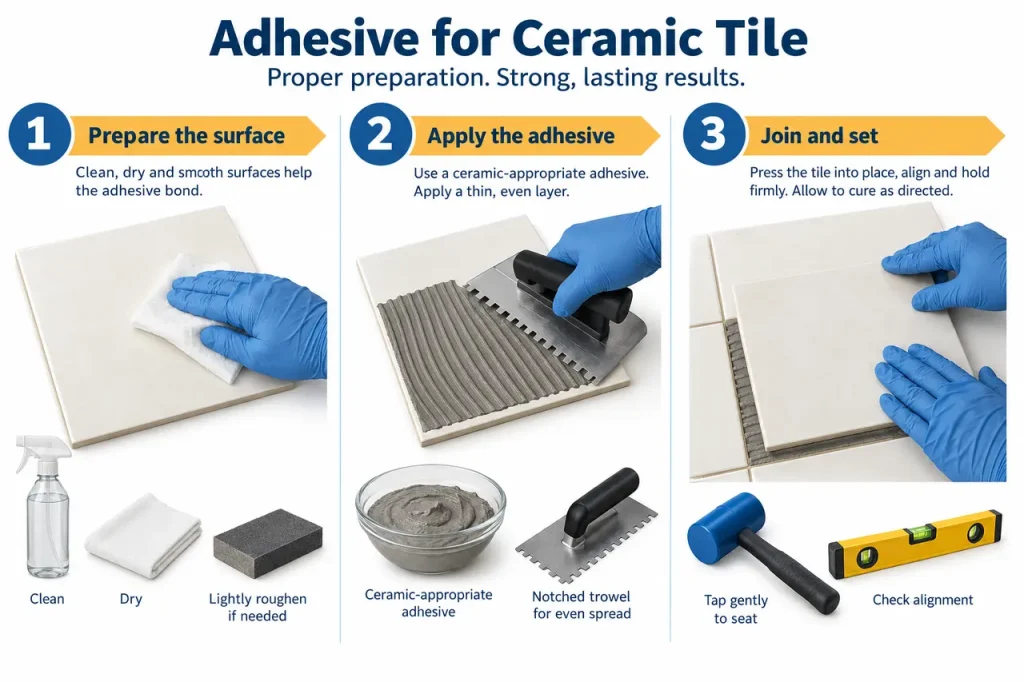
Good adhesion requires a stable surface. When installing tile, assess the substrate rather than just cleaning the tile face. A weak, moving or moisture-damaged backing cannot be corrected with a stronger glue.
Steps for Surface Preparation
- Identify the material underneath the tile and confirm it is allowed for the selected mortar.
- Check that the backing is sufficiently stable and properly prepared for tile.
- Remove dust, grease, loose coatings and bond-breaking residues.
- Inspect cracks, loose tiles, failed grout and water damage before covering them.
- Apply primers, waterproof membranes or other preparation only as specified by the complete system.
- For attachments to existing glazed tile, follow the mounting adhesive’s surface preparation and weight instructions.
Importance of Dryness
Many substrates must be clean and dry before application, but some cement mortars or installation systems have specific substrate moisture or dampening requirements. Do not impose a universal “bone dry” rule or saturate the substrate without permission. Use the conditions stated by the mortar, primer and membrane makers.
Tools for Preparation
- Suitable cleaning tools and protective equipment.
- Level or straightedge for substrate flatness.
- Manufacturer-approved mixing vessel and low-speed mixing tool where needed.
- Appropriate notched trowel and spacers.
- Equipment to check mortar coverage and surface condition.
Expert Tips for Successful Tile Installation
Selecting the Right Adhesive
For Installing New Tiles
Match the mortar to the specific tile, substrate and exposure. For example, Schluter notes that certain DITRA assemblies have their own mortar choices, including unmodified mortar in specified applications. A liquid polymer additive is neither universally necessary nor universally permitted.
For Small Repairs on Glazed Tile
For a chip or ceramic-object repair, a compatible repair adhesive may be suitable after cleaning and surface preparation. For a heavy mirror, grab bar or loaded shelf, use a secure mounting design that accounts for the backing and load; adhesive on glaze alone may not be appropriate.
For Temporary Accessories
Use removable adhesive strips only where their own instructions permit the tile surface, bathroom humidity and item weight. Do not use decorative mounting products for safety-critical fixtures.
Application Tips for Adhesives
- Read the full current technical data sheet before mixing.
- Mix only with the specified amount of water or approved additive.
- Respect any required slake-and-remix step.
- Use the prescribed trowel and spread only an area that can be tiled within the open time.
- Press and move tiles to collapse ridges, then lift a sample tile to verify coverage.
- Allow required cure before grout, heavy traffic or water exposure.
- Provide movement joints and waterproofing components where specified by the tile system.
For perspective, MAPEI Ultraflex 2’s technical data sheet calls for more than 80% mortar contact on interior work and more than 95% for exterior and wet applications. These are system installation criteria, not simply a measure of how “strong” an adhesive feels.
Comparison Table of Adhesives
| Option | Use for | Do not assume |
|---|---|---|
| Modified thinset | Permitted tile-setting assemblies. | Every modified product works in pools or over every membrane. |
| Unmodified thinset | Assemblies requiring or accepting ANSI A118.1. | It is automatically suitable for plywood. |
| Premixed mastic | Listed wall-tile applications. | All wet locations are approved. |
| Repair epoxy or mounting adhesive | Small specific bonds on ceramic surfaces. | It can replace tile-setting mortar or anchors. |
Surface Preparation Steps
Inspect, clean and repair the correct substrate first. Apply the listed preparation, achieve required coverage and allow the system’s stated curing time. If an existing tile has come loose because the wall behind it is wet or unstable, address the backing before reattaching tile.
Action Point
For an installation, save the technical data sheets for the mortar, substrate and membrane before work starts. For an accessory, save the mounting system’s approved-surface and load instructions.
Conclusion
The best adhesive for ceramic tile depends on the task, surface and exposure. Polymer-modified thinset often arrives with polymer already blended into the powder and requires only water; unmodified thinset is valid in systems that call for it. Mastic, epoxy mortar and general repair adhesives have distinct uses and restrictions.
Do not add latex to every mortar, assume every product works over a waterproof membrane, or rely on waterproof claims as proof of pool or shower suitability. Match the entire tile assembly to the exact manufacturer instructions for a lasting installation.
Frequently Asked Questions
What is the best adhesive for ceramic tile installations in high-moisture areas?
Use a tile-setting mortar and waterproofing system specifically approved for that wet location and substrate. There is no one product suitable for every shower, pool or steam-room installation.
Can I use Tile Mastic for kitchen backsplashes?
Often yes, if the manufacturer approves that backsplash substrate, tile size and exposure. Check heat and moisture restrictions before choosing it.
Is Epoxy Mortar a good choice for outdoor tile projects?
Some products are, but only if the specific epoxy mortar and complete installation system are approved for outdoor exposure, movement and substrate conditions. Many exterior projects use approved cement-based mortar.
How do I prepare the surface for ceramic tile installation?
Inspect the substrate’s stability and flatness, remove contaminants, address damage and apply any required primer or waterproofing system. Follow the selected mortar’s moisture and surface instructions.
Can Gorilla Glue be used for ceramic tiles?
A compatible Gorilla-branded repair product may bond certain ceramic items, but it should not replace an approved tile-setting mortar for conventional floor or wall installation.
Do all thinset mortars require a latex additive?
No. Many polymer-modified thinsets have dry polymer in the bag and require only water. Others use a specified liquid additive, while unmodified thinset may be mixed with water for approved applications.
Can I use unmodified thinset over a waterproofing membrane?
Sometimes. The answer depends on the membrane manufacturer’s instructions. Some assemblies specifically call for ANSI A118.1 unmodified mortar, while others require modified mortar.
Does thinset mortar waterproof a shower?
No. Where required, a compatible waterproofing membrane and correctly constructed shower assembly provide waterproofing; mortar and grout alone are not adequate substitutes.
What Adhesive Sticks to Ceramic Tile: Practical Selection Checks
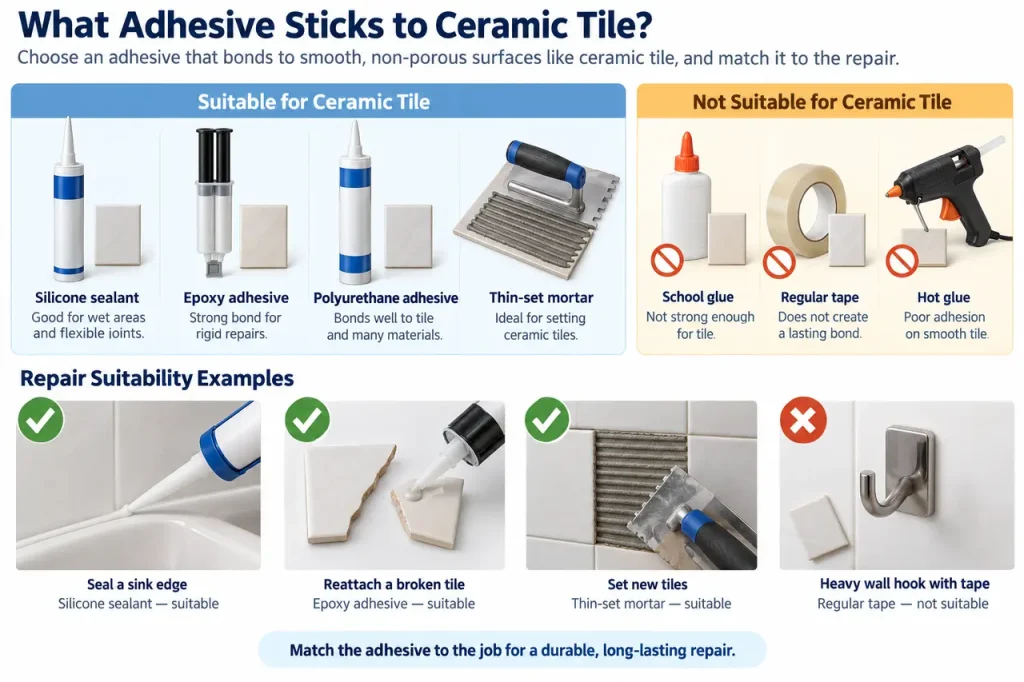
| Situation | Practical choice | Check |
|---|---|---|
| Set a floor tile | Approved thinset system. | Backing, coverage, movement and cure. |
| Set a dry interior wall tile | Approved thinset or permitted premixed adhesive. | Tile size and substrate restrictions. |
| Set tile in a shower or outdoors | Complete exposure-approved system. | Waterproofing, membrane compatibility and environmental limits. |
| Attach an accessory to glaze | Rated mounting method. | Load, tile finish and mechanical support. |
Preparation for What Adhesive Sticks to Ceramic Tile
Before opening an adhesive, answer four questions: What material are you bonding? What is behind it? Will it be wet, heated or loaded? Does the exact product list the combination as suitable? These checks matter more than a generic strength label.
Failure Checks: What Adhesive Sticks to Ceramic Tile
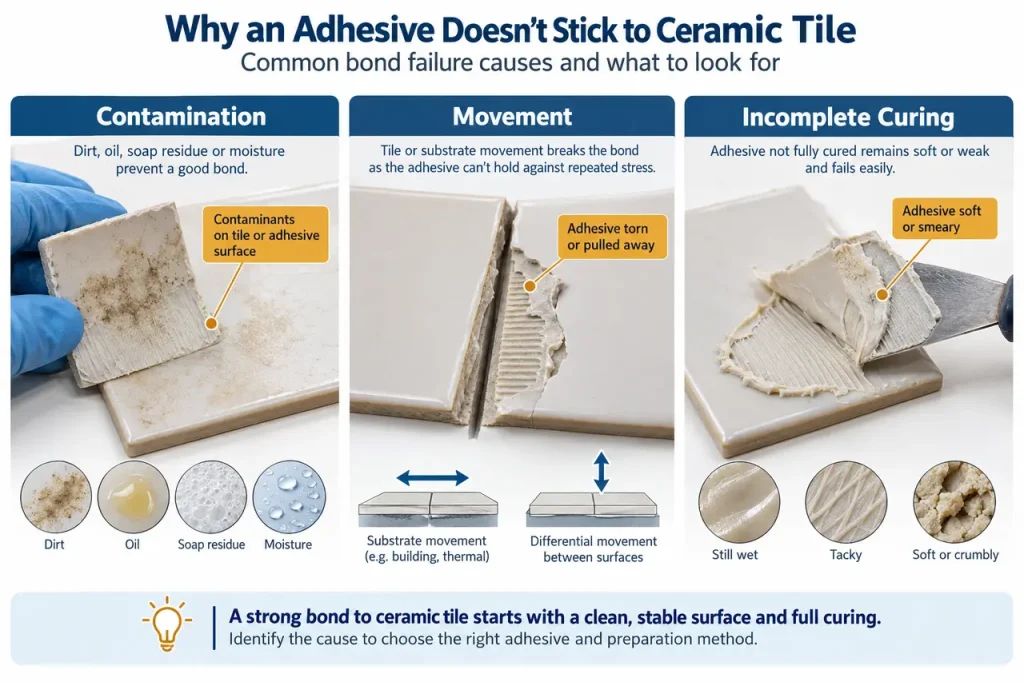
If adhesive fails, check for contamination, a loose substrate, insufficient mortar coverage, unapproved wet exposure, movement, incorrect mixing or premature use. A strong adhesive cannot compensate for a weak backing or a missing waterproofing layer.